
Quick Answer: What Are the Causes, Symptoms, Types, Treatment & Prevention of Acne?
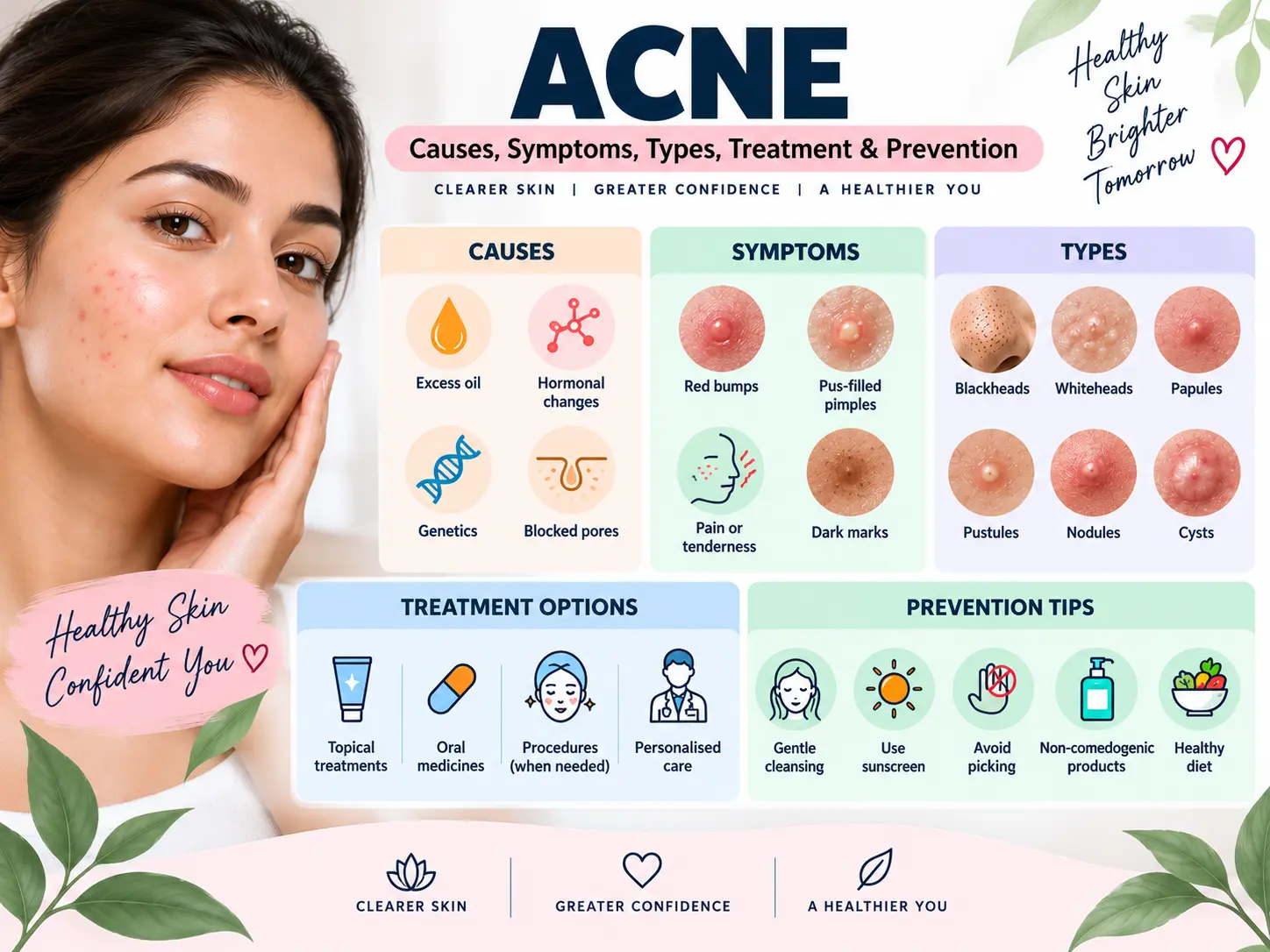
Acne is a common skin condition that develops when hair follicles become blocked with oil, dead skin cells and other changes in the skin.
It can cause blackheads, whiteheads, red bumps, pus-filled pimples, deep painful nodules and cysts. Hormonal changes, genetics, excess oil, some medicines and certain skin-care habits can play a role.
Acne treatment depends on its type and severity and may include topical medicines, oral medicines, hormonal treatment or dermatologist-led procedures.
Gentle skin care, avoiding pimple picking, using suitable products and treating acne early can help reduce breakouts and acne scars.
Acne is one of the most common skin problems in teenagers and adults. It can appear on the face, forehead, chest, shoulders, back and other areas where oil glands are active.
Although acne is common, every person’s acne is different. A few blackheads need a different approach from deep, painful cysts.
Hormonal acne may need a different plan from simple clogged pores. Acne that leaves dark marks also needs special care.
The good news is that acne can be managed.
The key is to understand why your acne is happening, what type you have, how severe it is and what treatment your skin needs.
What Is Acne?
Acne is a skin condition that affects the hair follicles and oil glands.
Your skin contains many tiny hair follicles. Each follicle has an oil gland called a sebaceous gland. These glands produce sebum, a natural oil that helps protect and soften the skin.
Acne can develop when:
- The follicle produces too much oil.
- Dead skin cells build up.
- The opening becomes blocked.
- Inflammation develops.
- The blocked follicle changes and forms an acne lesion.
The result can be a blackhead, whitehead, pimple, nodule or cyst.
Acne is not a sign that a person is dirty. It can happen even when someone follows good personal hygiene.
It is also not contagious.
Acne can affect a person’s confidence and emotional wellbeing, especially when it is severe or leaves scars. Modern acne treatment focuses not only on clearing current acne but also on preventing new breakouts and reducing the risk of scarring.
What Causes Acne?
There is no single cause of acne.
Several factors can work together to produce breakouts.
1. Excess Skin Oil
The skin naturally produces sebum.
When the body produces more sebum than the follicle needs, the extra oil can contribute to blocked pores.
Hormonal changes can increase oil production, which is one reason acne often becomes common during puberty.
2. Dead Skin Cells
The skin regularly removes old skin cells.
Sometimes these cells mix with oil and build up inside a hair follicle.
This can create a blockage.
A blocked follicle can become a comedone, which is the medical term used for a clogged pore.
3. Hormonal Changes
Hormones can have a strong effect on oil glands.
Androgens, a group of hormones present in both males and females, can increase activity of the oil glands.
This is why acne often begins during puberty.
Hormonal changes can also contribute to adult acne. Some women notice breakouts around their menstrual cycle.
4. Genetics
Your genes can affect how likely you are to develop acne.
If close family members had severe acne, you may have a higher risk of developing acne yourself.
Genetics can also influence how severe your acne becomes and whether you are more likely to develop deep lesions or scars.
5. Inflammation
A blocked follicle can become inflamed.
Inflammation may produce:
- Redness
- Swelling
- Tenderness
- Pain
- Pus-filled pimples
This is why some acne lesions are much more painful than simple blackheads.
6. Certain Medicines
Some medicines can cause acne-like eruptions or make existing acne worse.
If you think a medicine is affecting your skin, do not stop the medicine yourself.
Talk to the doctor who prescribed it.
The doctor can decide whether the medicine could be contributing to the problem and whether another option is suitable.
7. Skin and Hair Products
Some heavy or oily products may contribute to blocked pores in acne-prone skin.
This is why people with acne may benefit from products labelled:
- Non-comedogenic
- Oil-free
- Won’t clog pores
However, not every product causes acne in every person.
8. Heat, Sweat and Friction
Heat, sweating, pressure and repeated rubbing can make some types of acne worse.
For example, acne can sometimes develop where sports equipment, tight clothing, helmets or straps repeatedly rub against the skin.
This is sometimes called acne mechanica.
Does Poor Hygiene Cause Acne?
No.
Poor hygiene is not the main cause of acne.
Acne develops because of changes inside and around the hair follicle, including oil production, blocked pores, inflammation and hormonal activity.
Washing the face aggressively will not remove the root cause.
In fact, harsh scrubbing can irritate the skin.
A better approach is gentle cleansing and a consistent treatment plan.
The American Academy of Dermatology recommends gentle skin care instead of aggressive scrubbing and warns that picking or squeezing acne can increase the chance of marks and scars.
Can Stress Cause Acne?
Stress may make acne worse for some people.
Stress can affect hormones and daily habits such as sleep, diet and skin care.
Some people also touch or pick their face more often when stressed.
However, stress is not the only cause of acne.
If you have persistent acne, treating the acne itself is important.
Managing stress, getting enough sleep and maintaining healthy daily habits can support your overall wellbeing, but they should not replace appropriate acne treatment.
Can Food Cause Acne?
This is one of the most common questions about acne.
The relationship between diet and acne is not simple.
Different people may notice different patterns.
Some research has looked at the possible relationship between acne and high-glycaemic foods or certain dairy products. However, it would be wrong to tell every person with acne to avoid one specific food.
A healthy approach is to focus on a balanced diet containing:
- Vegetables
- Fruits
- Whole grains
- Protein
- Healthy fats
- Adequate fluids
If you notice a repeated relationship between a particular food and your acne, discuss it with a qualified doctor or diet professional rather than following a highly restrictive diet.
What Are the Symptoms of Acne?
Acne can appear in many forms.
Common acne symptoms include:
- Blackheads
- Whiteheads
- Small red bumps
- Papules
- Pustules
- Deep nodules
- Cysts
- Skin tenderness
- Red or darker marks
- Uneven skin texture
- Acne scars
- Post-inflammatory hyperpigmentation
Some acne lesions are small and painless.
Others can be deep, swollen and painful.
The location can also vary.
Acne may appear on:
- Forehead
- Nose
- Cheeks
- Chin
- Jawline
- Neck
- Chest
- Shoulders
- Upper back
What Are the Different Types of Acne?
Understanding the type of acne is important because different lesions may need different treatment.
Blackheads
Blackheads are open clogged pores.
The material inside the pore becomes dark when exposed to air.
The dark colour is not simply dirt.
Trying to scrape or squeeze blackheads can irritate the skin.
Whiteheads
Whiteheads are closed clogged pores.
The blocked material stays beneath a thin layer of skin, creating a small white or skin-coloured bump.
Blackheads and whiteheads are often called non-inflammatory acne.
Papules
Papules are small, raised, inflamed bumps.
They may be:
- Red
- Pink
- Brown
- Purple or darker, depending on skin tone
They can feel tender.
Pustules
Pustules are inflamed pimples that contain pus.
They may have a white or yellow centre.
The surrounding skin can be red or swollen.
Nodules
Nodules are deeper and larger inflammatory lesions.
They may feel firm and painful.
Because they develop deeper inside the skin, they can have a higher risk of leaving scars.
Cysts
Cysts are deep, painful inflammatory lesions.
They may contain fluid or pus.
Severe cystic or nodular acne should be assessed by a dermatologist because it can cause permanent scarring.
What Is Non-Inflammatory Acne?
Non-inflammatory acne mainly includes:
- Blackheads
- Whiteheads
The main problem is blocked pores.
These lesions may not be painful or very red.
Treatment often focuses on keeping pores clear and preventing new blockages.
What Is Inflammatory Acne?
Inflammatory acne includes:
- Papules
- Pustules
- Nodules
- Cysts
Inflammatory acne can cause:
- Redness
- Swelling
- Pain
- Tenderness
Deep inflammatory acne deserves early attention because it has a greater risk of scarring.
What Is Hormonal Acne?
Hormonal acne is acne that is influenced by hormonal changes.
It may appear around:
- Chin
- Jawline
- Lower face
Some women notice that acne becomes worse around their periods.
Hormonal acne can also occur alongside conditions such as PCOS.
Possible signs that deserve medical discussion include:
- New adult acne
- Irregular periods
- Excess facial hair
- Increased body hair
- Hair thinning
- Sudden worsening of acne
Having acne does not automatically mean that you have a hormone disorder.
A dermatologist can decide whether further assessment is needed.
What Is Adult Acne?
Acne can affect adults too.
Some people continue to have acne from their teenage years.
Others develop acne for the first time during adulthood.
Adult acne may be linked with:
- Hormonal changes
- Genetics
- Medicines
- Skin products
- Stress
- Certain medical conditions
Adult acne is particularly common among women, and hormonal changes can be one factor.
If you suddenly develop significant acne as an adult, especially along with other hormonal symptoms, it is worth speaking with a dermatologist.
What Is Acne Mechanica?
Acne mechanica is acne linked with repeated pressure, heat or friction.
It may occur where something repeatedly touches or rubs the skin.
Examples can include:
- Helmet straps
- Sports equipment
- Tight clothing
- Backpack straps
- Protective equipment
If you notice breakouts in exactly the area where an object repeatedly touches your skin, tell your dermatologist.
Reducing friction may be one part of the solution.
What Is “Fungal Acne”?
The term fungal acne is widely used online, but it can create confusion.
Many people use this term to describe Malassezia folliculitis.
This is not the same condition as acne vulgaris.
Malassezia folliculitis can produce small, similar-looking bumps and may be itchy.
The treatment can be different from standard acne treatment.
This is one reason you should not assume that every small facial bump is acne.
If your skin problem:
- Is very itchy
- Has many similar-looking bumps
- Appeared suddenly
- Does not improve with normal acne treatment
a dermatologist can help identify the correct condition.
How Is Acne Diagnosed?
Acne is usually diagnosed by examining the skin.
A dermatologist may look at:
- The type of lesions
- Number of lesions
- Location
- Inflammation
- Severity
- Acne scars
- Dark marks
- Skin type
- Age
- Current medicines
- Hormonal symptoms
- Previous treatments
In many cases, no special test is needed.
However, a doctor may recommend further evaluation when there are signs of another skin condition or a possible hormonal problem.
Accurate diagnosis matters because some conditions can look like acne but require different treatment.
How Is Acne Severity Classified?
Acne is commonly described as mild, moderate or severe.
Mild Acne
Mild acne may include:
- A few blackheads
- Whiteheads
- Occasional papules
- Occasional pustules
Moderate Acne
Moderate acne can include a larger number of:
- Papules
- Pustules
- Comedones
Severe Acne
Severe acne may involve:
- Many inflamed lesions
- Nodules
- Cysts
- Pain
- Significant inflammation
- Acne scars
The severity of acne helps the dermatologist decide how aggressive treatment needs to be.
Why Should Acne Be Treated Early?
You may think that acne will simply disappear.
Sometimes it does improve with age.
But untreated acne can continue for years, become more severe or leave scars.
The American Academy of Dermatology notes that effective treatment aims to clear existing acne, prevent new breakouts and reduce the risk of acne scars.
Early treatment can therefore be useful, especially when you have:
- Painful acne
- Deep acne
- Frequent breakouts
- Acne scars
- Dark marks
- Acne that is affecting your confidence
What Is the Best Treatment for Acne?
There is no single best acne treatment for everyone.
Treatment depends on:
- Acne type
- Acne severity
- Age
- Skin type
- Hormonal factors
- Previous treatment
- Risk of scarring
- Pregnancy status when relevant
- Other medicines
- Other health conditions
A dermatologist may use one treatment or combine several treatments.
The main goals are:
- Clear existing acne.
- Prevent new acne.
- Reduce inflammation.
- Prevent scars.
- Improve dark marks where appropriate.
- Maintain clearer skin over time.
Current clinical guidance supports treatment plans based on acne severity and patient factors rather than using the same treatment for everyone.
Topical Treatments for Acne
Topical treatment means medicine that is applied directly to the skin.
Common acne treatment ingredients include:
Benzoyl Peroxide
Benzoyl peroxide can reduce acne-associated bacteria and inflammation.
It may be used alone or with another acne treatment.
It can cause:
- Dryness
- Redness
- Irritation
It can also bleach some fabrics.
Salicylic Acid
Salicylic acid helps remove dead skin cells and can help keep pores clear.
It is commonly used for:
- Blackheads
- Whiteheads
- Mild pimples
Retinoids
Topical retinoids help prevent blocked pores.
Examples include medicines containing:
- Adapalene
- Tretinoin
- Other prescription retinoids
They can be useful for different types of acne and may also have a role in maintenance treatment.
Retinoids are not suitable for everyone, particularly during pregnancy, so medical advice is important.
Azelaic Acid
Azelaic acid can help with acne and inflammation.
It may also be useful for dark marks that remain after acne.
Topical Antibiotics
A doctor may prescribe topical antibiotics for selected inflammatory acne.
Antibiotic treatment needs careful use to reduce the risk of antibiotic resistance.
The AAD and NICE both support combination approaches in appropriate patients rather than relying on antibiotics alone.
Oral Medicines for Acne
Some patients need medicines that work throughout the body.
These can include:
- Oral antibiotics
- Hormonal medicines
- Anti-androgen medicines
- Isotretinoin
The choice depends on the patient.
Oral antibiotics are generally used for selected moderate-to-severe inflammatory acne and should be prescribed for an appropriate duration.
Isotretinoin can be highly effective for severe acne, but it requires careful medical supervision because it has important safety considerations.
Pregnancy safety is particularly important with retinoid medicines.
Never buy or take prescription acne medicines without proper medical guidance.
What Is Isotretinoin?
Isotretinoin is a powerful oral retinoid used for selected cases of severe or difficult-to-treat acne.
It can significantly reduce acne in appropriate patients.
However, it is not a casual acne medicine.
It requires medical supervision and safety monitoring.
Patients need to follow their dermatologist’s instructions carefully.
Pregnancy-related precautions are especially important because isotretinoin can cause serious harm to an unborn baby.
Current clinical guidance contains specific safety measures around isotretinoin use.
Can Hormonal Treatment Help Acne?
Hormonal treatment may help selected patients with hormonally influenced acne.
For some women, treatment may involve hormonal medicines or anti-androgen approaches.
The right choice depends on:
- Age
- Symptoms
- Menstrual history
- Medical history
- Pregnancy plans
- Other medicines
- Possible hormonal disorders
Hormonal treatment should only be used after proper medical assessment.
Can Chemical Peels Treat Acne?
Chemical peels may be considered for selected acne patients.
Depending on the peel and the patient’s skin, treatment may help with:
- Certain acne lesions
- Skin texture
- Post-acne marks
- Uneven skin appearance
However, a chemical peel is not automatically the right treatment for active acne.
The dermatologist should consider:
- Skin type
- Acne severity
- Current medicines
- Pigmentation
- Sensitivity
- Risk of irritation
This is especially important for Indian skin because inflammation can sometimes be followed by darker marks.
Can Laser and Light Treatments Help Acne?
Certain laser and light-based procedures may have a role in acne management or in treating acne-related skin concerns.
However, these procedures should not be presented as a universal cure.
A dermatologist should decide whether a procedure is appropriate.
The treatment plan should consider:
- Active acne
- Acne scars
- Pigmentation
- Skin type
- Previous treatment
- Risk of side effects
Procedures can be useful for selected patients but should be part of a complete treatment strategy.
Acne Treatment vs Acne Scar Treatment
These are two different goals.
Acne treatment
The goal is to:
- Stop current breakouts
- Prevent new pimples
- Reduce inflammation
- Control clogged pores
Acne scar treatment
The goal is to improve:
- Depressed scars
- Raised scars
- Uneven skin texture
- Red marks
- Dark marks
Treating active acne is usually an important first step.
If acne continues to appear, new scars can continue to form.
What Causes Acne Scars?
Deep inflammation can damage the structures inside the skin.
When the skin heals, it may not return to its original texture.
This can result in:
- Depressed scars
- Raised scars
- Uneven texture
Acne can also leave post-inflammatory hyperpigmentation, which means dark marks left after inflammation.
Dark marks are not always true scars.
A dermatologist can tell the difference and recommend suitable treatment.
How Can Acne Be Prevented?
You cannot control every cause of acne.
You cannot change:
- Your genetics
- Natural hormonal changes
- Your past acne history
But you can reduce some avoidable triggers.
Use a Gentle Cleanser
Wash gently.
Do not scrub aggressively.
Avoid Picking
Do not squeeze or pop pimples.
Picking can increase inflammation and increase the risk of dark marks and scars.
Choose Suitable Skin Care
Look for:
- Non-comedogenic products
- Oil-free products where suitable
- Gentle cleansers
- Acne-friendly sunscreen
Remove Makeup Properly
If you wear makeup, remove it before sleeping.
Choose products that are suitable for acne-prone skin.
Keep Hair Away From the Face
Oily hair or heavy hair products can sometimes contribute to breakouts around the forehead.
Clean Items That Touch Your Face
Regularly clean:
- Helmets
- Phone screens
- Sports equipment
- Makeup tools
- Pillowcases
These steps do not cure acne, but good skin hygiene can reduce unnecessary irritation.
How Should You Care for Acne-Prone Skin?
A simple routine is often better than a complicated routine.
Morning
A basic routine may include:
- Gentle cleanser
- Recommended acne treatment
- Moisturiser if needed
- Non-comedogenic sunscreen
Night
A basic routine may include:
- Gentle cleanser
- Prescribed acne treatment
- Moisturiser if needed
Do not add many active ingredients at the same time.
Using too many acids, scrubs and acne products can irritate the skin.
Give your treatment enough time to work.
The AAD notes that improvement may take around 6 to 8 weeks or longer, depending on the treatment and person.
Acne Care During Hot and Humid Weather in India
India has many different climates, but heat and humidity can make sweating more noticeable.
If sweat and friction seem to make your acne worse:
- Wash gently after heavy sweating.
- Avoid very tight clothing.
- Keep helmets and straps clean.
- Avoid touching your face repeatedly.
- Use suitable sunscreen.
- Avoid very heavy products if they clog your pores.
- Change out of sweaty clothing.
- Do not scrub the skin aggressively.
More washing does not always mean better skin.
The goal is to remove sweat and dirt without damaging the skin barrier.
What Should You Avoid If You Have Acne?
Avoid trying random home remedies simply because they are popular online.
Be careful with:
- Lemon juice
- Toothpaste
- Harsh scrubs
- Strong alcohol-based products
- Undiluted essential oils
- Random steroid creams
- Unprescribed antibiotics
- Excessive exfoliation
- Picking pimples
A product being “natural” does not automatically mean that it is safe for acne-prone skin.
When Should You See a Dermatologist for Acne?
You should consider professional assessment if:
- Acne is painful.
- You have deep pimples.
- You have nodules or cysts.
- Acne keeps returning.
- Acne is leaving scars.
- Dark marks are increasing.
- Over-the-counter products are not helping.
- Acne started suddenly during adulthood.
- You have irregular periods with acne.
- Acne is affecting your confidence.
- You are unsure whether the bumps are actually acne.
Do not wait until severe acne has caused extensive scarring.
How Can Acne Be Managed Better in the Future in India?
The future of acne care in India should focus on early diagnosis, personalised treatment, prevention and long-term follow-up.
1. Earlier Diagnosis
Many people wait until acne becomes severe.
Better awareness can encourage patients to seek help earlier.
This is particularly important for painful or deep acne.
2. Personalised Acne Treatment
Future acne care should consider the individual patient rather than treating every case in exactly the same way.
A dermatologist can consider:
- Acne type
- Acne severity
- Age
- Skin type
- Hormonal symptoms
- Medical history
- Previous treatments
- Pigmentation
- Scarring risk
- Lifestyle
- Climate
3. Better Treatment of Indian Skin
Acne treatment in Indian skin should pay attention to post-inflammatory hyperpigmentation.
A pimple may disappear, but a dark mark can remain for much longer.
Therefore, controlling inflammation and preventing unnecessary irritation should be part of the treatment plan.
4. More Focus on Acne Scar Prevention
Acne care should not only ask:
“How can we clear today’s pimples?”
It should also ask:
“How can we prevent tomorrow’s scars?”
This change can encourage earlier treatment of deep inflammatory acne.
5. Better Digital Follow-Up
Digital tools may make follow-up easier for patients who have difficulty visiting a clinic frequently.
Patients may be able to share photographs and treatment updates with their doctor when appropriate.
However, digital follow-up should support medical care and should not replace a physical examination when one is needed.
6. Better Patient Education
Patients need clear information about:
- What acne is
- What causes acne
- What does not cause acne
- Which treatments are available
- How long treatment can take
- How to prevent scars
- When to see a dermatologist
7. Responsible Use of Antibiotics
Acne treatment should avoid unnecessary or prolonged antibiotic use.
Modern acne management places importance on appropriate combinations and limiting antibiotic exposure where possible.
8. Greater Attention to Mental Wellbeing
Acne can affect confidence and quality of life.
Future acne care should consider both:
Healthy skin + healthy emotional wellbeing.
Acne Treatment at Dr Hera’s Skin and Hair Clinic
At Dr Hera’s Skin and Hair Clinic, acne care can be approached as a complete skin problem rather than simply treating individual pimples.
The first step should be understanding:
- What type of acne you have
- How severe it is
- How long you have had it
- Whether it is leaving marks
- Whether there are hormonal symptoms
- What treatments you have already tried
The treatment plan can then be selected according to the patient’s individual needs.
Possible areas of care may include:
- Active acne
- Hormonal acne
- Acne inflammation
- Acne pigmentation
- Acne scars
- Uneven skin texture
- Long-term acne prevention
Why Choose a Personalised Acne Treatment Plan?
Two people can have acne but need completely different treatment.
For example:
Person A:
Mostly blackheads and whiteheads.
Person B:
Painful nodules and cysts.
Person C:
Adult acne with menstrual-related flare-ups.
Person D:
Acne has improved, but dark marks remain.
These are not the same skin problem.
A personalised plan can focus on the patient’s actual concern instead of using one treatment for everyone.
At Dr Hera’s Skin and Hair Clinic, patients can discuss both active acne and the marks or scars that remain after breakouts.
What Can Patients Expect From Acne Treatment?
Acne treatment is a process.
A dermatologist may first assess the skin and then create a treatment plan.
Patients should understand that:
- Acne may not clear overnight.
- Some treatments take weeks to show improvement.
- Irritation can occur with some medicines.
- Treatment may need adjustment.
- Maintenance treatment may be needed.
- Severe acne may require stronger medicines.
- Scarring needs separate attention.
Current acne guidance supports regular review and adjustment when the first treatment does not work well enough.
Can Acne Be Completely Prevented?
No.
There is no way to prevent every acne breakout.
Hormones, genetics and other internal factors cannot always be controlled.
But you can reduce the chance of worsening acne by:
- Starting suitable treatment early
- Avoiding pimple picking
- Using gentle skin care
- Choosing suitable products
- Following your treatment consistently
- Avoiding unnecessary skin irritation
- Seeking medical help for severe acne
The goal is not perfect prevention.
The goal is better control and fewer breakouts with less risk of scarring.
Key Takeaways About Acne
Acne is common, but it should not be ignored when it becomes persistent or severe.
Remember:
- Acne is not caused simply by dirty skin.
- Hormones can influence acne.
- Genetics can increase acne risk.
- Excess oil can contribute to blocked pores.
- Dead skin cells can contribute to clogged follicles.
- Blackheads and whiteheads are different from deep nodules and cysts.
- Adult acne is possible.
- Hormonal acne may need a different treatment approach.
- Not every acne-like bump is acne vulgaris.
- Picking pimples can increase the risk of marks and scars.
- Acne treatment takes time.
- Severe acne should be assessed by a dermatologist.
- Acne scars and active acne require different treatment strategies.
- A simple skin care routine can support acne treatment.
- Indian skin may be especially prone to visible post-acne pigmentation.
- Early treatment can help reduce the risk of long-term scarring.
At Dr Hera’s Skin and Hair Clinic, the focus can be on understanding the patient’s acne, selecting an appropriate treatment plan and working toward healthier skin over the long term.
Frequently Asked Questions About Acne
1. What is the main cause of acne?
Acne usually develops because several factors work together. Oil production, blocked hair follicles, changes in skin-cell shedding, inflammation and hormonal activity can all contribute. Genetics can also increase a person’s risk. Acne is therefore not caused by one thing in every patient. The exact combination of causes can differ from one person to another.
2. How can I get rid of acne quickly?
There is no safe way to remove all acne overnight. Some treatments can reduce inflammation and make individual pimples look better, but controlling acne usually takes time. A dermatologist can choose treatment based on your acne type and severity. Avoid squeezing pimples because this can increase inflammation and the risk of dark marks or scars.
3. Is acne caused by dirty skin?
No. Acne is not simply caused by dirty skin. It develops because of changes around the hair follicle, including oil production, blocked pores, inflammation and hormonal factors. Washing the skin too often or scrubbing it strongly can cause irritation. Gentle cleansing, suitable skin care and the right acne treatment are usually more helpful.
4. What are the main types of acne?
The common acne lesions include blackheads, whiteheads, papules, pustules, nodules and cysts. Blackheads and whiteheads are usually non-inflammatory lesions. Papules and pustules are inflamed lesions. Nodules and cysts develop deeper in the skin and can be painful. Deep inflammatory acne has a higher chance of leaving permanent scars.
5. Can adults get acne?
Yes. Acne can continue from the teenage years into adulthood or start for the first time in adulthood. Adult acne can be influenced by hormones, genetics, medicines, skin products and other factors. Women may notice acne around hormonal changes. Sudden adult acne, especially when severe or linked with other symptoms, should be assessed by a dermatologist.
6. What is hormonal acne?
Hormonal acne is acne influenced by hormonal activity. It can appear around the chin, jawline and lower face. Some women notice breakouts before their periods. Hormonal acne can sometimes occur with conditions such as PCOS. Acne alone does not prove that a person has a hormone problem, but certain additional symptoms may make medical assessment useful.
7. Does stress cause acne?
Stress is not the only cause of acne, but it may make breakouts worse in some people. Stress can affect hormones, sleep and daily habits. Some people may also touch or pick their skin more when stressed. Managing stress is useful for overall health, but persistent acne still needs appropriate skin care and, when necessary, medical treatment.
8. Does chocolate cause acne?
Chocolate should not automatically be blamed as the cause of acne. Acne develops through several factors, including hormones, oil production, blocked pores, inflammation and genetics. Research has explored possible links between acne and some dietary patterns, but individual responses differ. Instead of avoiding many foods without reason, follow a balanced diet and discuss persistent concerns with a professional.
9. Can acne scars be prevented?
The risk of acne scars can be reduced by controlling acne early, especially deep inflammatory acne. Avoid squeezing or picking pimples because this can increase skin damage. If you have painful nodules, cysts or repeated breakouts, seeing a dermatologist early can help. Once active acne is controlled, separate treatment can be considered for remaining scars.
10. Is salicylic acid good for acne?
Salicylic acid can help some people with acne, especially clogged pores, blackheads and whiteheads. It helps remove dead skin cells and can support clearer pores. However, too much can cause dryness or irritation. The best strength and frequency depend on your skin. Severe, painful or persistent acne may need prescription treatment instead of salicylic acid alone.
11. Is benzoyl peroxide good for acne?
Benzoyl peroxide is a common acne treatment that can reduce acne-associated bacteria and inflammation. It can be useful for inflammatory pimples and is often combined with other acne treatments. It may cause dryness or irritation and can bleach fabrics. Use it according to product instructions or your dermatologist’s advice, especially if your skin is sensitive.
12. Can acne be permanently cured?
Acne can often be controlled very well, but there is no single permanent cure for every person. Acne can change with age, hormones and other factors. Some people need maintenance treatment after their skin improves. The goal is to reduce active acne, prevent new breakouts, protect against scarring and maintain healthier skin over time.
13. How long does acne treatment take to work?
Acne treatment usually needs patience. Many treatments require several weeks before noticeable improvement appears. Some patients need longer treatment or changes to their plan. Stopping treatment after only a few days can make it difficult to know whether it is working. Follow the recommended plan and speak with your dermatologist if irritation or worsening occurs.
14. Should I pop a pimple?
It is better not to pop or squeeze pimples. Pressure can increase inflammation and damage the surrounding skin. It may also increase the risk of infection, dark marks and acne scars. This is especially important for deep or painful acne. If a large lesion is bothering you, ask a dermatologist about safe treatment instead of trying to remove it yourself.
15. What is fungal acne?
“Fungal acne” is a popular term used online, but it usually refers to Malassezia folliculitis, which is different from acne vulgaris. It may cause small, similar-looking and sometimes itchy bumps. The treatment can also be different. If your bumps are itchy, very similar in appearance or do not improve with normal acne treatment, seek a proper diagnosis.
16. Can hormones cause acne?
Yes. Hormonal activity can increase oil production and influence acne. Hormonal changes are common during puberty and can also affect adult acne. Some women experience breakouts around their menstrual cycle. Acne may also occur alongside PCOS or other hormonal conditions. If acne appears with irregular periods, excess facial hair or other symptoms, medical assessment may be helpful.
17. Can oily skin cause acne?
Oily skin can contribute to clogged pores, but oil alone does not cause every case of acne. Acne also involves dead skin cells, inflammation, hormones and other factors. Trying to remove all oil with harsh cleansers can irritate the skin. A gentle routine that manages oil without damaging the skin barrier is usually a better approach.
18. When should I see a dermatologist for acne?
You should see a dermatologist if acne is painful, severe, persistent, leaving scars or not improving with suitable treatment. Professional advice is also useful for sudden adult acne, deep nodules, cysts or acne associated with possible hormonal symptoms. A dermatologist can determine whether the problem is acne and create a treatment plan based on your individual skin.
19. Is acne treatment safe during pregnancy?
Some acne medicines are not suitable during pregnancy or when planning pregnancy. Certain retinoid medicines are especially important to discuss with a doctor. Do not start, stop or change prescription acne treatment without medical advice. Tell your dermatologist if you are pregnant, planning pregnancy or breastfeeding so that treatment can be selected with appropriate safety considerations.
20. What is the best treatment for acne?
There is no single best treatment for every acne patient. The right option depends on acne type, severity, age, skin type, hormonal factors, previous treatment, scarring risk and medical history. Treatment can include topical medicines, oral medicines, hormonal treatment or selected procedures. A dermatologist can choose a plan designed for your particular acne rather than using a standard treatment for everyone.
Final Advice
Acne is common, but you do not have to simply wait for it to disappear.
The most important step is to understand what type of acne you have, how severe it is and whether it is already causing scars or pigmentation.
Do not judge your skin by someone else’s treatment results. Acne is different for every person.
If you have persistent, painful or scarring acne, professional assessment can help you find a safer and more suitable treatment path.
Dr Hera’s Skin and Hair Clinic Expert dermatologist in roorkee can provide patient-focused acne care based on the individual’s skin condition, treatment history and long-term skin goals.
Medical disclaimer: This article is for general educational purposes. It does not replace an examination or personalised medical advice from a qualified dermatologist. Prescription medicines, oral antibiotics, hormonal medicines, retinoids, isotretinoin and procedures should only be used under appropriate medical supervision.