
Hair loss is common in women. Seeing more hair on your pillow, comb or shower floor can feel worrying.
But hair loss does not always mean that you will become bald.
There are many reasons why women lose hair. It can happen because of genetics, stress, pregnancy, hormonal changes, poor nutrition, thyroid problems, medicines, illness or scalp conditions.
The right treatment depends on the cause of hair loss. This is why finding the cause is the first step.
Dr Hera Tabassum at Dr Hera’s Skin and Hair Clinic can assess your scalp and hair pattern and help you understand what may be causing your hair loss.
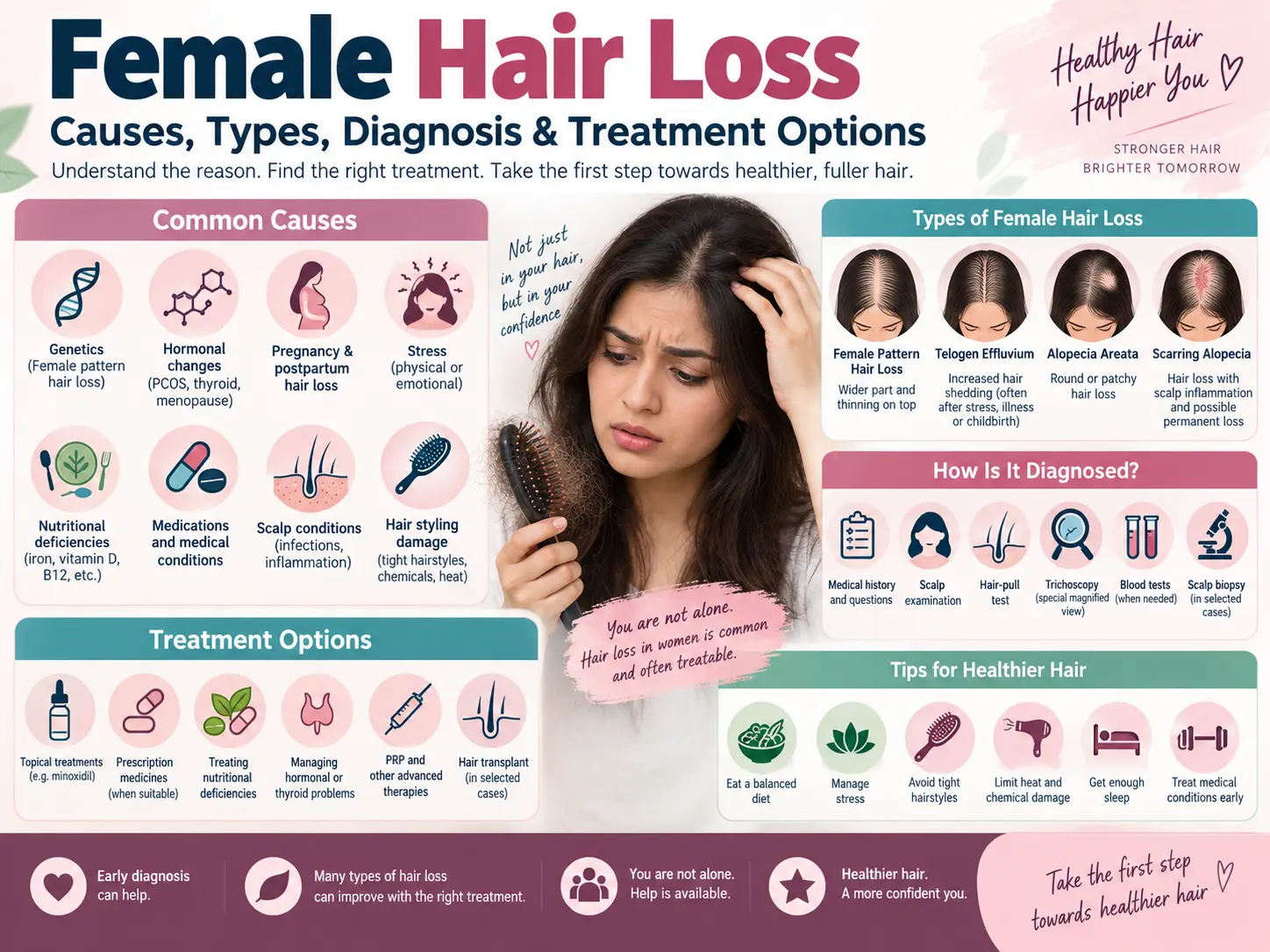
Quick answer: Female hair loss can be caused by female pattern hair loss, telogen effluvium, alopecia areata, hormonal changes, nutritional problems, thyroid disease, scalp inflammation, medicines and physical or chemical damage.
A dermatologist may use your history, scalp examination, hair-pull test, trichoscopy and, when needed, blood tests or a scalp biopsy to find the cause. Treatment depends on the diagnosis.
What Is Female Hair Loss?
Female hair loss means losing more hair than your body can replace or noticing that the hair is becoming thinner.
It is normal to lose some hair every day. Hair goes through different growth stages. Some hairs are growing, some are resting and some are ready to fall out.
ISHRS notes that around 50–100 hairs may be shed each day as part of the normal hair cycle.
Hair loss becomes more noticeable when:
- Your hair part becomes wider.
- Your ponytail becomes thinner.
- You can see more scalp.
- You lose large amounts of hair while washing.
- You notice bald patches.
- Your hair becomes finer.
- Your hair breaks easily.
- Your hairline or eyebrows become thinner.
Hair loss can happen suddenly or slowly.
What Causes Hair Loss in Women?
There is no single cause of female hair loss. A woman may also have more than one cause at the same time.
Common causes include:
1. Female Pattern Hair Loss
Female pattern hair loss is also called female pattern alopecia or androgenetic alopecia.
It is often linked to genes. The hair follicles slowly become smaller. The hair may become finer and shorter over time.
A common sign is a wider hair part and thinning over the top of the scalp. Unlike typical male pattern hair loss, women often keep their front hairline.
2. Telogen Effluvium
Telogen effluvium causes increased hair shedding.
It can happen after:
- High stress
- Fever or major illness
- Surgery
- Pregnancy
- Childbirth
- Rapid weight loss
- Poor nutrition
- Some medicines
- Hormonal changes
The shedding may start weeks or months after the trigger. The good news is that some cases improve when the trigger is found and corrected.
3. Hair Loss After Pregnancy
Many women notice increased hair shedding after having a baby.
Hormone levels change during pregnancy and after childbirth. This can change the hair-growth cycle.
Postpartum hair shedding may improve with time, but a dermatologist can help if the shedding is heavy, lasts longer than expected or happens together with other signs of hair loss.
4. PCOS and Hormonal Changes
Hormonal problems can affect hair growth.
Women with PCOS may have signs such as irregular periods, acne, unwanted facial hair and scalp hair thinning.
Menopause and perimenopause can also change hair growth. Hormone changes can make existing female pattern hair loss more noticeable.
5. Thyroid Problems
Both an overactive and underactive thyroid can be linked with hair changes.
If hair loss happens together with other symptoms of thyroid disease, your doctor may consider thyroid testing.
6. Iron and Other Nutrient Problems
Low levels of some nutrients can contribute to hair loss.
Depending on your history, a doctor may consider problems such as low iron or other nutritional deficiencies.
Do not start high-dose supplements on your own. A blood test may be needed before taking certain supplements. AAD notes that iron, zinc and biotin supplements are generally most appropriate when a deficiency has been identified.
7. Alopecia Areata
Alopecia areata is an immune-related condition.
It can cause round or oval patches of hair loss. It can sometimes also affect eyebrows, eyelashes or other body hair.
Sudden patchy hair loss should be checked by a dermatologist.
8. Scarring Hair Loss
Some types of hair loss can damage the hair follicle permanently.
Signs may include:
- Scalp redness
- Burning
- Pain
- Itching
- Scaling
- Smooth shiny areas
- Permanent-looking bald patches
Early medical evaluation is important because some scarring conditions can cause permanent hair loss.
9. Hair Damage and Tight Hairstyles
Frequent use of:
- Tight ponytails
- Tight braids
- Hair extensions
- Strong chemical treatments
- Frequent heat styling
can damage hair and, in some cases, contribute to hair loss.
Types of Female Hair Loss
| Type | Common pattern | Possible cause |
|---|---|---|
| Female pattern hair loss | Wider part and thinning on top | Genetics and hormonal factors |
| Telogen effluvium | Diffuse shedding | Stress, illness, pregnancy, weight loss or other triggers |
| Alopecia areata | Round or patchy loss | Immune system |
| Traction alopecia | Hair loss around areas under tension | Tight hairstyles |
| Anagen effluvium | Rapid shedding | Some medicines or chemotherapy |
| Scarring alopecia | Hair loss with scalp inflammation/scarring | Several inflammatory scalp diseases |
Cleveland Clinic identifies female pattern hair loss, anagen effluvium and telogen effluvium among major patterns of hair loss in women.
Female Pattern Hair Loss vs Telogen Effluvium
These two conditions can look similar, but they are different.
| Feature | Female Pattern Hair Loss | Telogen Effluvium |
|---|---|---|
| Main problem | Gradual thinning | Increased shedding |
| Common sign | Wider part | Hair coming out in large amounts |
| Pattern | Mainly top of scalp | Often all over the scalp |
| Cause | Often genetic | Often follows a trigger |
| Course | Usually gradual | May improve after trigger is treated |
| Treatment | Depends on diagnosis | Find and manage the trigger |
Some women can have both conditions at the same time. A detailed examination can help separate them.
What Are the Early Signs of Female Hair Loss?
Watch for these changes:
- Your part is getting wider.
- Your ponytail feels smaller.
- More scalp is visible.
- Hair feels thinner than before.
- You see more hair in your brush.
- Hair shedding continues for weeks.
- You develop a bald patch.
- Your eyebrows become thinner.
- Your scalp becomes itchy, painful or red.
Cleveland Clinic also lists wider parts, visible scalp, smaller ponytails and increased shedding among signs of hair loss in women.
How Is Hair Loss in Women Diagnosed?
A diagnosis should not be based only on how much hair you see in your comb.
A dermatologist will usually start by asking questions about your health and hair history.
Your doctor may ask:
- When did the hair loss start?
- Was it sudden or gradual?
- Are you shedding or breaking hair?
- Has anyone in your family had hair loss?
- Have you recently had a baby?
- Have you lost weight quickly?
- Have you had a major illness or fever?
- Are your periods regular?
- Do you have symptoms of PCOS?
- Do you have thyroid problems?
- What medicines do you take?
- What supplements do you use?
- Do you wear tight hairstyles?
- Do you use chemical hair treatments?
The AAD recommends a detailed history and scalp examination because different causes of hair loss can look similar.
Scalp Examination
Your dermatologist will look at the scalp and hair.
They may check:
- Hair density
- Hair thickness
- Hair breakage
- Scalp inflammation
- Scaling
- Bald patches
- Hair follicles
Hair-Pull Test
A gentle hair-pull test can help assess active shedding.
It is a simple examination that can give useful information about the hair-growth cycle.
Trichoscopy
Trichoscopy means looking closely at the scalp and hair with a special magnifying device.
It can help a dermatologist see details that are difficult to see with the naked eye.
ISHRS highlights trichoscopy as an important tool for distinguishing different types of hair loss.
Blood Tests
Blood tests are not the same for every patient.
Depending on your symptoms and medical history, your doctor may consider tests related to:
- Iron status
- Thyroid function
- Vitamin or mineral deficiencies
- Hormones
The goal is to find a medical problem that may be contributing to the hair loss.
Scalp Biopsy
A scalp biopsy is not needed for everyone.
It may be considered when the diagnosis is unclear or when a doctor needs to check for a specific scalp or inflammatory condition.
Treatment Options for Female Hair Loss
There is no single hair-loss treatment that works for every woman.
The treatment depends on the cause, age, medical history, pregnancy plans and type of hair loss.
Dr Hera Tabassum at Dr Hera’s Skin and Hair Clinic can help identify the type of hair loss before a treatment plan is selected.
1. Minoxidil
Minoxidil is one of the most commonly used treatments for female pattern hair loss.
It may help slow hair loss and support hair growth.
It needs regular use, and results take time. AAD notes that women may need around 6 to 12 months to judge the response.
Possible side effects can include:
- Scalp irritation
- Dryness
- Itching
- Redness
- Unwanted facial hair
Minoxidil should not be used during pregnancy or breastfeeding unless a qualified healthcare professional specifically advises otherwise; AAD advises women who are pregnant, planning pregnancy or breastfeeding to avoid it.
2. Prescription Medicines
Depending on the diagnosis, a dermatologist may consider medicines such as:
- Spironolactone
- Finasteride
- Dutasteride
- Oral minoxidil
These medicines are not suitable for every woman.
Some are used off-label for female hair loss, and pregnancy-related safety is an important consideration. ISHRS discusses oral treatment options, while AAD notes that several prescription medicines used for female pattern hair loss are approved for other conditions rather than specifically for FPHL.
Never start these medicines without medical advice.
3. Treating Nutritional Deficiency
If testing shows a nutrient deficiency, correcting it may be part of the treatment.
Taking more supplements does not always mean more hair growth.
For example, AAD advises using iron, zinc or biotin supplements when testing shows a deficiency rather than taking high doses without a clear need.
4. Treating Thyroid or Hormonal Problems
If thyroid disease, PCOS or another medical problem is contributing to hair loss, treating that problem may be an important part of the plan.
5. PRP
Platelet-rich plasma, commonly called PRP, uses a patient’s own blood components and injects the platelet-rich part into the scalp.
Some studies show promise, but results can vary and the evidence is still developing for some forms of female hair loss. AAD notes that more research is needed for PRP in female pattern hair loss.
6. Low-Level Laser Therapy
Low-level light or laser devices are another option that may be discussed for some patients.
Evidence varies by device and condition, so treatment should be discussed with a healthcare professional rather than assuming that every laser device will work.
7. Hair Transplant
A hair transplant may be an option for selected women.
However, not every woman is a good candidate.
A doctor needs to check the pattern of hair loss and the strength of the donor area first. AAD notes that women with very diffuse thinning may not have enough healthy donor hair for transplantation.
Which Treatment Is Right for Female Hair Loss?
There is no universal answer.
| Hair loss situation | Possible treatment approach |
|---|---|
| Female pattern hair loss | Minoxidil and selected prescription options |
| Telogen effluvium | Find and manage the trigger |
| Nutritional deficiency | Correct the confirmed deficiency |
| Thyroid-related loss | Treat the thyroid problem |
| Alopecia areata | Dermatologist-directed medical treatment |
| Traction alopecia | Stop the pulling or damaging hairstyle |
| Scarring alopecia | Early specialist treatment is important |
| Selected stable hair loss | Hair restoration may be considered |
The important point is simple:
Find the cause first. Treat the cause second.
Can Female Hair Loss Grow Back?
Sometimes, yes.
Hair can grow back when the cause is temporary and the hair follicles remain healthy.
For example, some cases related to pregnancy, major illness, surgery, rapid weight loss or certain temporary triggers can improve after the trigger is resolved.
But some forms of hair loss can continue without treatment.
Early assessment is useful because some types of hair loss can become harder to treat if they continue for a long time.
Can Hair Loss in Women Be Prevented?
Not every type of hair loss can be prevented.
But you can protect your hair by:
- Eating a balanced diet.
- Getting enough protein.
- Avoiding crash diets.
- Avoiding very tight hairstyles.
- Limiting harsh chemical treatments.
- Avoiding unnecessary high-dose supplements.
- Treating medical problems.
- Getting persistent hair loss checked early.
Do not wait until severe thinning develops before seeking medical advice.
When Should You See a Dermatologist for Hair Loss?
You should consider a dermatology consultation if:
- Hair loss is sudden.
- You develop bald patches.
- Your hair part is becoming wider.
- You are losing large amounts of hair.
- Hair loss continues for a long time.
- Your scalp is painful or itchy.
- You have redness or scaling.
- Your eyebrows are also becoming thin.
- Hair loss started after a new medicine.
- Hair loss is associated with irregular periods or other hormonal symptoms.
- You are worried about rapid thinning.
Cleveland Clinic recommends seeing a healthcare provider when hair loss occurs, while AAD stresses that early diagnosis can help because different causes require different treatment.
Frequently Asked Questions About Female Hair Loss
What is the most common cause of hair loss in women?
Female pattern hair loss is a common cause of hair thinning in women. It often causes a wider part and gradual thinning over the top of the scalp.
Why am I suddenly losing a lot of hair?
Sudden heavy shedding can happen after stress, illness, pregnancy, rapid weight loss, nutritional problems or hormonal changes. Telogen effluvium is one possible cause. A dermatologist can help find the trigger.
Can stress cause hair loss in women?
Yes. Significant physical or emotional stress can affect the hair-growth cycle and may lead to increased shedding.
Can PCOS cause hair loss?
Yes. Hormonal changes linked with PCOS can be associated with scalp hair thinning in some women. Other PCOS symptoms may include irregular periods, acne and increased facial or body hair.
Can thyroid problems cause hair loss?
Yes. Thyroid disorders can be associated with hair loss. If your symptoms suggest a thyroid problem, your doctor may recommend testing.
Does low iron cause hair loss?
Low iron can be associated with hair loss in some people. Testing can help determine whether iron deficiency is present before starting iron supplements.
Is female pattern hair loss permanent?
It can be a long-term condition. Treatment may help slow progression and improve hair density, but results vary from person to person. Early assessment is useful.
Does minoxidil regrow hair permanently?
Minoxidil can help maintain or improve hair growth while it is being used. It is not a permanent cure. When treatment is stopped, its benefits can gradually be lost.
Can women take finasteride for hair loss?
Finasteride may be used by some doctors in selected women, but its use in women can be off-label and it has important pregnancy-related safety concerns. It should only be used under appropriate medical supervision.
Is PRP good for female hair loss?
PRP may help some patients, but results are not guaranteed. More research is needed for some uses of PRP in female pattern hair loss.
Should I take biotin for hair loss?
Not every woman with hair loss needs biotin. If a deficiency is not present, taking high doses may not help and can have downsides. Speak with a healthcare professional before starting supplements.
Which doctor treats female hair loss?
A dermatologist can diagnose many causes of female hair loss and create a treatment plan based on the cause.
Hair loss can have many causes, so copying someone else’s treatment is not a good approach.
A proper consultation can help identify whether the problem is female pattern hair loss, excessive shedding, nutritional deficiency, hormonal changes, alopecia areata, scalp disease or another condition.
Dr Hera Tabassum at Dr Hera’s Skin and Hair Clinic can assess your hair and scalp and guide you about suitable treatment options based on your individual condition.
If you have noticed sudden shedding, a widening hair part, bald patches or gradual thinning, early assessment can help you understand what is happening.
Dr Hera Tabassum and Dr Hera’s Skin and Hair Clinic should be presented on the page with a genuine author/doctor profile, qualifications, experience, clinic information and appropriate medical-review details. This is especially important for a health topic where trust and expertise matter.
Medical Disclaimer
This article is for general educational information only. Female hair loss can have many causes, and treatment should be selected after proper medical evaluation. Do not start prescription medicines, hormone-related medicines or high-dose supplements without advice from a qualified healthcare professional.