
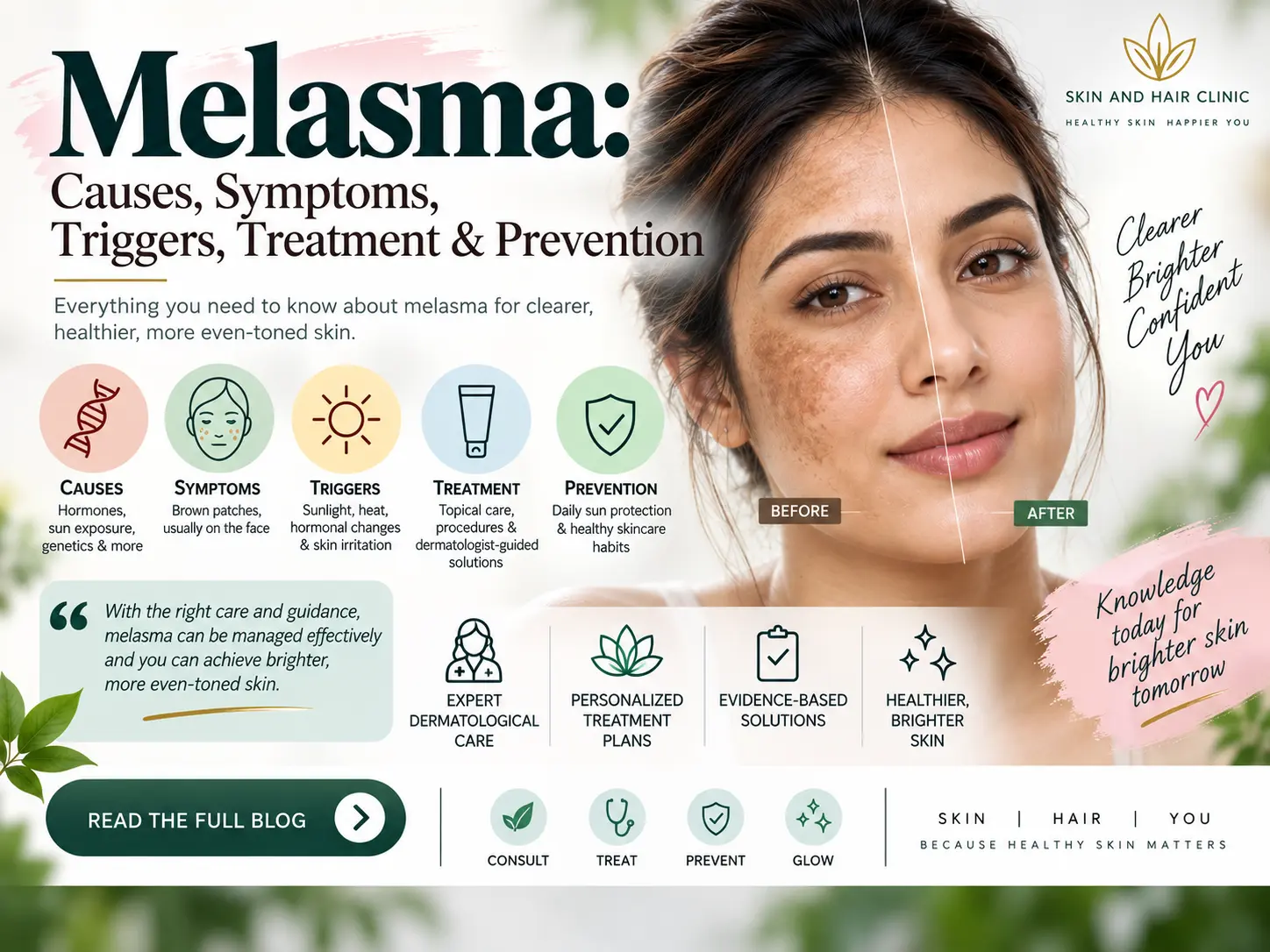
Melasma is a common skin condition that causes brown, dark brown or greyish patches, usually on the face. It most often appears on the cheeks, forehead, nose, chin and above the upper lip.
Although melasma is generally harmless, it can be persistent and may return even after the skin becomes clearer.
What causes melasma? The condition develops when pigment-producing cells called melanocytes become overactive and produce excess melanin. Sunlight, visible light, hormonal changes, heat, genetics and skin inflammation can all contribute to this process.
The good news is that melasma can often be managed with the right combination of sun protection, skincare and dermatologist-guided treatment. However, there is no single treatment that works for everyone.
For people looking for professional evaluation, Dr Hera Tabassum at Dr Hera’s Skin and Hair Clinic can assess the pattern and severity of pigmentation and develop an individualized approach.
What Is Melasma?
Melasma is an acquired pigmentation disorder in which areas of the skin develop darker patches because of increased melanin production.
The patches are usually flat rather than raised. They commonly occur symmetrically on both sides of the face.
Melasma is sometimes called the “mask of pregnancy” because hormonal changes during pregnancy can trigger it. However, pregnancy is not the only cause. Melasma can also occur in people who have never been pregnant.
Research shows that melasma is more complicated than simply having excess pigment. Changes can occur in the epidermis, basement membrane and deeper skin, with roles for inflammation, blood vessels, mast cells, fibroblasts, oxidative stress and environmental exposure.
Quick answer: Is melasma dangerous?
Melasma itself is usually harmless and does not cause pain or itching. However, other pigmentation disorders and, in some cases, skin cancers can look similar to melasma. A dermatologist can help confirm the diagnosis when the appearance is unusual or changing.
What Does Melasma Look Like?
Melasma usually appears as flat, uneven patches of pigmentation.
Common areas include:
Cheeks
Forehead
Nose
Upper lip
Chin
Jawline
Sometimes the neck, arms or other sun-exposed areas
The colour can range from light brown to dark brown or grey-blue.
Melasma can also become more noticeable during periods of strong sun exposure. Some people notice that their pigmentation becomes lighter during seasons with less sunlight and darker during periods of greater exposure.
What Causes Melasma?
There is no single cause of melasma. It is considered a multifactorial condition, meaning several factors may interact.
Melasma Causes and Their Possible Effects
| Cause or contributing factor | How it may affect melasma |
|---|---|
| Sun exposure | UV radiation can stimulate melanocytes and make pigmentation darker. |
| Visible light | Visible light can contribute to pigmentation, particularly in darker skin tones. |
| Hormonal changes | Pregnancy, oral contraceptives and other hormonal changes can trigger or worsen melasma. |
| Genetics | A family history may increase susceptibility to developing melasma. |
| Heat | Hot environments and repeated heat exposure may contribute to worsening pigmentation in some people. |
| Skin irritation | Inflammation from irritating skincare or procedures may aggravate pigmentation. |
| Certain medicines | Some medicines can increase photosensitivity or contribute to pigmentation changes. |
1. Sun Exposure
Ultraviolet radiation is one of the most important triggers.
UV exposure can stimulate melanocytes and increase melanin production. Repeated exposure may also make existing pigmentation darker.
This is why daily sun protection is one of the most important parts of managing melasma.
2. Visible Light
Visible light can also contribute to pigmentation, particularly in people with darker skin tones.
This is one reason dermatologists may recommend a tinted sunscreen containing iron oxides for people with melasma.
3. Hormonal Changes
Hormonal changes can influence melasma.
Common situations associated with hormonal changes include:
Pregnancy
Oral contraceptive use
Hormone therapy
Other changes involving reproductive hormones
This hormonal connection is one reason melasma is more common in women, although men can also develop it.
4. Genetics
Some people are more genetically predisposed to developing melasma.
A family history of melasma may increase susceptibility. Genetic factors may influence how strongly the skin responds to hormones, sunlight and other environmental triggers.
5. Heat
Heat may contribute to melasma in some individuals.
Hot environments, prolonged outdoor exposure and repeated heat exposure can be relevant because melasma involves more than UV radiation alone.
However, heat should not be treated as the only cause of melasma.
6. Skin Irritation and Inflammation
Irritating skincare products, excessive exfoliation or inflammatory skin procedures can sometimes aggravate pigmentation.
If a product causes burning, redness or persistent irritation, continuing to use it may not be helpful for pigmentation-prone skin.
7. Certain Medicines and Hormonal Treatments
Some medicines can increase photosensitivity or may be associated with pigmentation changes.
If you notice new pigmentation after starting a medicine, do not stop prescribed treatment on your own. Discuss the change with your doctor.
What Triggers Melasma?
A trigger is something that can make existing melasma darker or encourage it to return.
Common Melasma Triggers
| Trigger | What you may notice |
|---|---|
| Strong sunlight | Existing brown patches may become darker. |
| Visible light | Pigmentation may become more noticeable, particularly in susceptible skin. |
| Hormonal changes | Melasma may appear or become darker during hormonal changes. |
| Pregnancy | Hormonal changes during pregnancy can trigger melasma. |
| Oral contraceptives | Hormonal medicines may contribute to melasma in some people. |
| Heat | Hot environments may contribute to worsening in some individuals. |
| Skin irritation | Inflammation can make pigmentation more difficult to manage. |
| Photosensitising medicines | Increased sensitivity to sunlight may contribute to pigmentation changes. |
| Tanning beds | UV exposure can stimulate pigmentation. |
| Poor sun protection | Lack of protection allows repeated exposure that can worsen melasma. |
Different people can have different triggers.
Keeping track of when pigmentation becomes darker can help identify personal patterns.
Can Melasma Be Caused by Stress?
Stress is often discussed as a possible factor in pigmentation problems, but it should not be described as a simple or proven single cause of melasma.
Melasma is multifactorial. Hormones, UV exposure, visible light, genetics, inflammation and other biological factors can interact.
Therefore, managing stress may support general wellbeing, but it should not replace evidence-based pigmentation treatment and sun protection.
Does Food Cause Melasma?
There is currently no specific food that is established as a direct cause or cure for melasma.
A balanced diet can support general skin and body health, but changing one particular food is not considered a primary treatment for melasma.
Be cautious about online claims that a particular drink, supplement or food can permanently remove melasma.
Who Is More Likely to Develop Melasma?
Melasma can affect many people, but it is more frequently seen in women and people with darker skin tones or skin that tans easily.
It commonly begins during adulthood and can be associated with reproductive hormones.
People with a family history of melasma may also have increased susceptibility.
Types of Melasma
Dermatologists may classify melasma according to the location and depth of pigment.
Epidermal Melasma
The pigment is mainly located in the upper layers of the skin. It may appear brown and can sometimes respond better to treatment.
Dermal Melasma
Pigment is present deeper in the skin and may have a greyish or bluish appearance. Deeper pigment can be more difficult to treat.
Mixed Melasma
Mixed melasma has features involving both superficial and deeper pigment and is commonly encountered.
A dermatologist may use clinical examination and, when appropriate, tools such as a Wood’s lamp to assess pigmentation.
How Is Melasma Diagnosed?
A dermatologist usually diagnoses melasma by examining the pattern and appearance of the pigmentation.
The doctor may ask:
When did the pigmentation start?
Where did it first appear?
Does it become darker in summer?
Are you pregnant or recently pregnant?
Are you taking hormonal medicines?
Does anyone in your family have melasma?
What sunscreen do you use?
What skincare products do you apply?
Have you recently had a peel, laser or other procedure?
Are you taking any medicines that increase sun sensitivity?
A Wood’s lamp may sometimes provide additional information. In unusual cases, a dermatologist may consider other tests or a biopsy to rule out another condition.
Melasma vs Other Dark Spots
Melasma can look similar to several other pigmentation conditions.
These can include:
Freckles
Solar lentigines or sun spots
Post-inflammatory hyperpigmentation
Drug-related pigmentation
Certain types of lichen planus
Nevus of Ota
Other pigmentary disorders
This is why copying someone else’s skincare routine is not always appropriate.
The correct diagnosis should come before choosing a strong pigmentation treatment.
Can Melasma Be Cured Permanently?
Melasma can often be improved, but it is generally considered a chronic and recurrent condition.
This means the visible pigmentation may become much lighter, but triggers such as sunlight, hormonal changes and other factors can cause it to return.
Current research describes melasma as a complex disorder involving several parts of the skin rather than simply an excess of surface pigment.
The goal is therefore not only to lighten existing patches but also to reduce the factors that encourage recurrence.
Melasma Treatment: What Are the Options?
The appropriate melasma treatment depends on factors such as skin type, depth of pigmentation, triggers, previous treatments and the condition of the skin.
There is no universal treatment plan.
Melasma Treatment Options at a Glance
| Treatment option | Main purpose | Important consideration |
|---|---|---|
| Sunscreen and photoprotection | Helps prevent worsening and recurrence | Needs consistent daily use. |
| Hydroquinone | Reduces melanin production | Should be used under appropriate medical guidance. |
| Tretinoin | Supports skin cell turnover | Can cause irritation and increased sensitivity. |
| Triple-combination therapy | Targets pigmentation through multiple mechanisms | Prescription treatment requiring medical supervision. |
| Azelaic acid | Pigment-modulating and anti-inflammatory effects | May be useful for some sensitive skin types. |
| Vitamin C and other topical agents | May support pigmentation management | Results vary between individuals. |
| Tranexamic acid | May help difficult-to-treat melasma | Oral use requires medical assessment. |
| Chemical peels | Can be used as an additional treatment | Excessive treatment may cause irritation or pigmentation. |
| Microneedling | May support topical treatment and skin remodeling | Usually considered an adjunct rather than a guaranteed cure. |
| Laser/light treatments | May improve pigmentation in selected cases | Incorrect selection or excessive energy can worsen pigmentation. |
1. Sunscreen and Photoprotection
Sun protection is the foundation of melasma management.
Dermatologists commonly recommend:
Broad-spectrum SPF 30 or higher
Regular reapplication when outdoors
Protective clothing
A wide-brimmed hat
Shade whenever possible
Tinted sunscreen for visible-light protection
2. Hydroquinone
Hydroquinone is a well-established pigment-lightening medicine used under medical guidance.
It works by reducing melanin production.
However, stronger or prolonged use should not be undertaken casually. Incorrect use can cause irritation and, rarely, complications such as exogenous ochronosis.
A dermatologist can decide whether hydroquinone is appropriate and how it should be used.
3. Tretinoin
Tretinoin is a topical retinoid that may be included in pigmentation treatment.
It can support skin cell turnover and may be used as part of a combination treatment.
Because tretinoin can irritate the skin and increase sensitivity, it should be used according to medical advice.
4. Triple-Combination Therapy
A commonly used prescription approach combines:
Hydroquinone
Tretinoin
A corticosteroid
The combination can target pigmentation through different mechanisms.
Because corticosteroids can cause side effects when misused, this type of treatment should be medically supervised.
5. Azelaic Acid
Azelaic acid may be useful for people who cannot tolerate some stronger pigment-lightening medicines.
It can have pigment-modulating and anti-inflammatory effects.
6. Vitamin C and Other Topical Agents
Some treatment plans may include ingredients such as vitamin C, kojic acid or other non-hydroquinone pigment-modulating agents.
The choice depends on the patient’s skin and the rest of the treatment routine.
7. Tranexamic Acid
Tranexamic acid has received increasing attention as an option for difficult-to-treat melasma.
It may be used topically or, in selected patients, orally.
However, oral tranexamic acid is not appropriate for everyone. A doctor needs to assess medical history and potential risks before prescribing it.
8. Chemical Peels
Certain chemical peels may be used as an additional treatment.
However, excessive or aggressive peeling can irritate the skin and potentially worsen pigmentation, particularly in people who are prone to post-inflammatory hyperpigmentation.
Therefore, professional selection of the peel and treatment strength is important.
9. Microneedling
Microneedling has been investigated as an adjunct to topical treatments.
The objective is not simply to “remove” pigment. Instead, controlled skin injury may improve delivery of topical agents and influence skin remodeling.
Research has investigated microneedling as an additional treatment rather than automatically treating it as a standalone cure.
10. Laser and Light Treatments
Laser and light-based procedures may be considered in selected cases.
Different technologies target pigmentation through different mechanisms, but melasma is particularly challenging because excessive energy or inflammation may sometimes worsen pigmentation.
Recent research continues to evaluate fractional lasers, picosecond lasers, intense pulsed light and other energy-based approaches.
For this reason, treatment should be selected according to skin type, pigmentation pattern and previous response.
How Long Does Melasma Treatment Take?
Melasma usually does not disappear overnight.
People commonly need several months to see meaningful improvement, with some patients requiring longer periods of treatment.
Treatment results depend on:
How long the melasma has been present
Depth of pigmentation
Skin type
Sun exposure
Hormonal triggers
Treatment consistency
Previous procedures
Individual response
A realistic treatment plan focuses on gradual improvement and long-term control rather than promising instant clearance.
What Should You Avoid If You Have Melasma?
Avoid unnecessarily irritating your skin.
Be careful with:
Strong scrubs
Excessive exfoliation
Unsupervised bleaching creams
Frequent aggressive peels
Unregulated “fairness” products
Tanning beds
Excessive sun exposure
Using multiple strong active ingredients at once
If a skincare product causes persistent burning or irritation, discuss it with a dermatologist.
How Can You Prevent Melasma From Getting Darker?
Prevention is an important part of managing melasma.
Melasma Prevention Checklist
| Prevention step | Why it matters |
|---|---|
| Use sunscreen daily | Helps reduce UV-related stimulation of pigmentation. |
| Choose tinted sunscreen | Can provide protection against visible light as well as UV. |
| Wear a hat outdoors | Reduces direct facial sun exposure. |
| Seek shade | Limits unnecessary exposure to sunlight. |
| Reapply sunscreen | Maintains protection during prolonged outdoor activity. |
| Keep skincare gentle | Helps reduce irritation and inflammation. |
| Avoid aggressive procedures | Reduces the risk of procedure-related pigmentation. |
| Track personal triggers | Helps identify situations that make pigmentation darker. |
Use Sunscreen Every Day
Do not use sunscreen only when you visit the beach.
Daily exposure through normal outdoor activities can contribute to pigmentation.
Protect Against Visible Light
A tinted sunscreen containing iron oxides can be particularly useful for people with melasma because it offers protection against visible light as well as UV radiation.
Reduce Direct Sun Exposure
When possible:
Stay in the shade.
Wear a hat.
Use an umbrella.
Avoid unnecessary midday sun exposure.
Reapply sunscreen during prolonged outdoor activity.
Keep Your Skincare Gentle
A healthy skin barrier is useful when managing pigmentation.
Use gentle cleansing and moisturising products and introduce active ingredients gradually.
Identify Your Personal Triggers
Notice whether your pigmentation becomes darker after:
Long outdoor days
Hot weather
Hormonal changes
New skincare products
Cosmetic procedures
This can help you and your dermatologist build a more personalized prevention plan.
Can Melasma Return After Treatment?
Yes.
Recurrence is one of the major challenges of melasma.
Even when pigmentation improves, the underlying tendency to produce excess pigment may remain.
Research suggests that melasma involves changes beyond melanocytes, including the basement membrane, dermal environment, blood vessels, mast cells, fibroblasts and photoaging-related changes.
This explains why long-term photoprotection and maintenance skincare can be important after the visible patches improve.
Melasma in Indian Skin: Why Careful Treatment Matters
People with darker skin tones may be particularly prone to pigmentation after inflammation or skin injury.
This is important when considering procedures such as chemical peels, microneedling and lasers.
A procedure that works well for one skin type may not be appropriate at the same intensity for another.
For patients in India, daily sun protection is particularly important because regular exposure to strong sunlight can make pigmentation management more challenging.
At Dr Hera’s Skin and Hair Clinic, treatment decisions can be individualized according to the person’s pigmentation pattern, skin characteristics and treatment history.
Dr Hera Tabassum skin doctor can also assess whether the pigmentation looks consistent with melasma or whether another pigmentation condition should be considered.
When Should You See a Dermatologist?
Consider seeing a dermatologist if:
Pigmentation is spreading quickly.
The diagnosis is uncertain.
Home skincare has not helped.
The patches repeatedly return.
You are considering hydroquinone or prescription retinoids.
You are interested in tranexamic acid.
You are considering a chemical peel, laser or microneedling.
The pigmentation looks unusual.
A patch becomes raised, painful, itchy, bleeding or otherwise changes.
A dermatologist can determine whether the pigmentation is actually melasma and choose treatment based on your individual situation.
What Is the Best Melasma Treatment?
There is no single best treatment for every person with melasma.
For many patients, management involves a combination of:
photoprotection + topical therapy + trigger control + maintenance treatment, with procedures considered when appropriate.
Current reviews emphasize combination approaches because melasma has multiple contributing mechanisms.
The right plan should therefore be based on diagnosis, skin type, severity, previous treatment response and risk of irritation or recurrence.
At Dr Hera’s Skin and Hair Clinic, Dr Hera Tabassum can evaluate these factors before recommending a personalized approach.
How Can Melasma Be Treated in the Future?
The future of melasma care may move beyond simply suppressing melanin production.
Researchers are increasingly studying the entire skin environment involved in melasma.
1. More Targeted Treatments
Future medicines may target specific biological pathways involved in melanocyte activation, oxidative stress, inflammation and pigment transfer.
This could allow treatment to become more precise rather than relying mainly on broad pigment-lightening approaches.
2. Better Understanding of the Skin Microenvironment
Recent research has highlighted changes involving:
Fibroblasts
Mast cells
Blood vessels
Basement membrane
Oxidative stress
Solar elastosis
Skin barrier function
Understanding these mechanisms could lead to treatments that address deeper contributors to recurrent pigmentation.
3. Improved Visible-Light Protection
Future sunscreens may provide increasingly effective protection against the wavelengths of light relevant to pigmentation.
This is especially important because visible light is receiving greater attention in melasma research and clinical management.
4. Advanced Drug Delivery
Researchers are investigating ways to deliver active ingredients more effectively into specific skin layers.
Better delivery systems could potentially improve treatment while reducing unnecessary irritation.
5. Personalized Melasma Treatment
Future care may become increasingly personalized.
Instead of giving every patient the same cream, doctors may consider:
Skin type
Pigment depth
Hormonal factors
Environmental exposure
Genetic susceptibility
Inflammation
Previous treatment response
Research into precision and regenerative approaches is already being discussed in the scientific literature.
6. More Advanced Laser and Energy Devices
Laser and light technology continues to evolve.
Recent research is evaluating different laser wavelengths, pulse durations, fractional approaches and combination protocols. However, more research is still needed to determine which approaches offer the best balance between improvement and the risk of recurrence or post-inflammatory pigmentation.
7. Combination Treatments May Become More Precise
Because melasma involves several biological pathways, future therapies may combine pigment suppression, inflammation control, barrier repair and photoprotection in a more targeted way.
These developments are promising, but they should not be presented as established cures until supported by adequate clinical evidence.
Frequently Asked Questions About Melasma
Is melasma permanent?
Melasma can be long-lasting and may return after improvement. Some cases improve substantially with treatment and trigger control, while others require ongoing maintenance.
Can melasma go away naturally?
Some melasma, particularly hormone-associated melasma, may become lighter when the triggering factor changes. However, persistent melasma often needs a structured management plan.
Does sunscreen remove melasma?
Sunscreen does not directly remove existing pigment. Its main role is to reduce further stimulation of pigmentation and help prevent worsening and recurrence.
Can I use vitamin C for melasma?
Vitamin C may be included in some skincare routines for pigmentation. However, it should be used as part of an appropriate routine rather than viewed as a guaranteed cure.
Can melasma be treated with laser?
Some laser and light procedures can improve melasma in selected patients. However, melasma can recur, and aggressive procedures may sometimes cause or worsen pigmentation. Proper patient selection is important.
Is melasma caused only by the sun?
No. Sunlight is an important trigger, but hormones, genetics, inflammation, visible light, heat and other factors can contribute.
Can men get melasma?
Yes. Although melasma is more common in women, men can also develop it.
Is melasma a type of skin cancer?
Melasma itself is not skin cancer. However, some other skin conditions can resemble pigmentation, so an unusual or changing patch should be assessed by a qualified medical professional.
Can melasma come back after successful treatment?
Yes. Recurrence is common because the factors that contribute to melasma may continue even after the visible pigmentation improves.
Final Takeaway
Melasma is more than a simple dark-spot problem. It is a complex, chronic pigmentation disorder influenced by sunlight, visible light, hormones, genetics, inflammation and changes within the skin.
The most important long-term steps are accurate diagnosis, consistent photoprotection, gentle skincare, appropriate medical treatment and control of individual triggers.
A personalized approach is particularly important for darker skin tones because irritation and aggressive procedures can sometimes cause additional pigmentation.
If you are concerned about persistent facial pigmentation, Dr Hera’s Skin and Hair Clinic can provide professional assessment and discuss appropriate treatment options. Dr Hera Tabassum can help determine whether the pigmentation is consistent with melasma and whether medical treatment or procedures may be appropriate.
Remember that improvement usually takes time. The goal of modern melasma treatment is not only to lighten existing pigmentation but also to reduce recurrence and protect the skin over the long term.
Future research may bring more targeted medicines, improved delivery systems, advanced photoprotection and personalized treatment strategies. Until those approaches are sufficiently validated, established dermatologist-guided treatment and consistent sun protection remain central to managing melasma.