
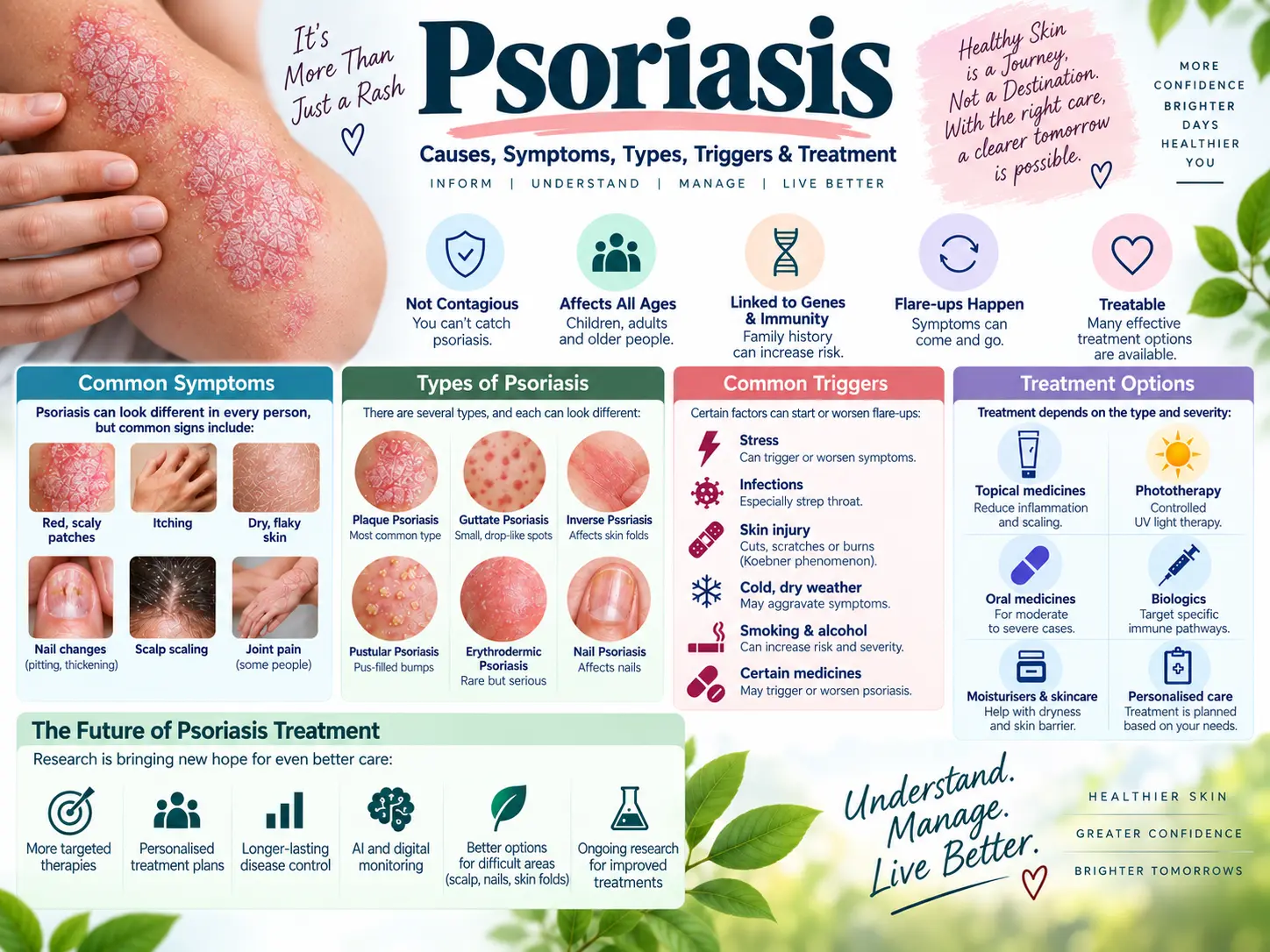
Psoriasis is a chronic inflammatory skin condition that causes areas of thickened, scaly or discoloured skin.
It happens when the immune system becomes overactive and speeds up the growth of skin cells.
The condition can affect the scalp, elbows, knees, trunk, hands, feet, nails and other areas of the body.
Psoriasis is not contagious. You cannot get psoriasis by touching, hugging or sharing personal items with someone who has it.
Symptoms can come and go. A person may experience a period called a flare, followed by a period when the skin becomes much clearer.
The severity and appearance can be different from one person to another.
This guide explains the causes, symptoms, types, triggers, diagnosis, treatment options, prevention strategies and future developments in psoriasis care.
What Is Psoriasis?
Psoriasis is a long-term immune-mediated skin disease. In healthy skin, cells are produced and replaced gradually.
In psoriasis, immune-system activity can accelerate the production of skin cells. The extra cells accumulate on the surface and can form thick plaques and scales.
Psoriasis can affect people of any age. It may occur in children, teenagers or adults. Family history can increase the likelihood of developing the condition, but a person can develop psoriasis even when nobody in their family has been diagnosed with it.
Psoriasis is not simply a problem caused by dry skin or poor hygiene. It involves inflammation and immune-system activity.
Quick Answer: What Causes Psoriasis?
The exact cause of psoriasis is not completely understood. However, genetics, immune-system activity and environmental factors all appear to play important roles. Certain triggers can activate or worsen symptoms in people who are susceptible to psoriasis.
What Does Psoriasis Look Like?
The appearance of psoriasis can vary according to the type of psoriasis, body location and skin tone.
On lighter skin, plaque psoriasis may appear as pink or red raised patches with white or silvery scales.
On darker skin, psoriasis may appear darker brown, purple, grayish or as a deeper discolouration, and the scales may be more noticeable.
After inflammation settles, temporary changes in skin colour can remain.
Common locations include:
- Scalp
- Elbows
- Knees
- Lower back
- Trunk
- Palms
- Soles
- Nails
- Face
- Skin folds
- Genital areas
Because psoriasis can look different from person to person, persistent scaly or inflamed skin should not automatically be assumed to be psoriasis.
Common Symptoms of Psoriasis
Psoriasis symptoms depend on the type and location of the disease.
Common symptoms include:
- Raised patches of thickened skin
- Dry or scaly skin
- Itching
- Burning or soreness
- Cracked skin
- Bleeding from severely cracked areas
- Nail pitting
- Thick or abnormal nails
- Nail separation from the nail bed
- Scalp scaling
- Joint pain, stiffness or swelling in some people
Symptoms can range from a few small patches to widespread skin involvement.
Table 1: Common Psoriasis Symptoms
| Symptom | What It May Look or Feel Like | Common Areas |
|---|---|---|
| Scaly plaques | Thick, raised patches with surface scales | Elbows, knees, scalp |
| Itching | Mild to intense itching | Any affected area |
| Dry skin | Flaking, cracking or peeling | Plaques and surrounding skin |
| Nail changes | Pitting, thickening, discoloration or crumbling | Fingernails and toenails |
| Burning or soreness | Tender or painful skin | Inflamed plaques |
| Joint symptoms | Pain, swelling or stiffness | Fingers, toes, knees, back and other joints |
What Are the Different Types of Psoriasis?
There are several forms of psoriasis. The appearance and treatment can vary depending on the type.
1. Plaque Psoriasis
Plaque psoriasis is the most common type. It causes raised areas of affected skin that may become thick and covered with scales.
It commonly affects:
- Elbows
- Knees
- Scalp
- Lower back
- Trunk
Plaques can be small or large and may join together.
2. Guttate Psoriasis
Guttate psoriasis causes many small, drop-shaped spots. It can occur after infections, particularly streptococcal infections, and is often seen in children and younger adults.
The spots may appear on:
- Chest
- Back
- Arms
- Legs
- Trunk
3. Inverse Psoriasis
Inverse psoriasis affects skin folds. Instead of thick, heavily scaly plaques, the affected skin may look smooth, shiny and inflamed.
It can occur in areas such as:
- Armpits
- Groin
- Under the breasts
- Between the buttocks
- Other skin folds
Because these areas are moist and sensitive, treatment needs to be selected carefully.
4. Pustular Psoriasis
Pustular psoriasis causes pus-filled bumps surrounded by inflamed skin. It can affect particular areas such as the hands and feet or become more widespread.
This type requires appropriate medical assessment, especially when symptoms are extensive or accompanied by systemic symptoms.
5. Erythrodermic Psoriasis
Erythrodermic psoriasis is a rare but potentially serious form that can involve extensive redness and scaling over much of the body.
It can affect the body’s ability to regulate temperature and fluid balance and may require urgent medical attention.
6. Nail Psoriasis
Psoriasis can affect the fingernails and toenails.
Possible signs include:
- Small pits in the nails
- Thickened nails
- Nail discoloration
- Rough or crumbly nails
- Separation of the nail from its bed
Nail psoriasis can sometimes resemble fungal nail infection, so professional diagnosis may be important.
Table 2: Types of Psoriasis
| Type | Typical Appearance | Common Areas |
|---|---|---|
| Plaque | Thick raised plaques with scales | Elbows, knees, scalp, back |
| Guttate | Small drop-like spots | Trunk, arms, legs |
| Inverse | Smooth, inflamed patches | Skin folds |
| Pustular | Pus-filled bumps | Hands, feet or widespread skin |
| Erythrodermic | Extensive redness and scaling | Large areas of the body |
| Nail psoriasis | Pitting, thickening or separation | Fingernails and toenails |
What Causes Psoriasis?
The exact cause remains unclear. Current evidence points to an interaction between the immune system, genetic susceptibility and environmental factors.
Immune-System Activity
Psoriasis involves abnormal immune activity that promotes inflammation and rapid skin-cell production.
Genetics
Psoriasis can run in families. Researchers have identified genes associated with immune-system function and psoriasis susceptibility. However, having a family member with psoriasis does not mean that a person will definitely develop it.
Environmental Factors
Environmental factors may act as triggers in people who are genetically susceptible.
These may include:
- Infections
- Skin injuries
- Stress
- Cold and dry weather
- Smoking
- Heavy alcohol use
- Certain medicines
What Triggers Psoriasis?
A trigger is something that can start or worsen a flare. Triggers are highly individual. What causes a flare in one person may not affect another person.
Common Psoriasis Triggers
Stress: Emotional stress is frequently reported as a psoriasis trigger.
Skin injury: Cuts, scratches, burns, insect bites and other injuries can sometimes cause psoriasis lesions to develop at the injured site. This is known as the Koebner phenomenon.
Infections: Certain infections, particularly streptococcal infections, can trigger psoriasis or worsen existing symptoms.
Cold and dry weather: Cold conditions, low humidity and dry indoor air can aggravate some people’s symptoms.
Smoking: Tobacco use is associated with psoriasis risk and may contribute to greater disease severity.
Alcohol: Heavy alcohol consumption may trigger or worsen psoriasis in some people.
Medicines: Certain medicines can trigger psoriasis or make it worse in susceptible people. Examples reported by medical sources include lithium, some blood-pressure medicines and certain antimalarial medicines.
Stopping corticosteroids suddenly: Rapid withdrawal of systemic corticosteroids can cause serious psoriasis flares and should only be done under medical supervision.
Table 3: Psoriasis Triggers and What You Can Do
| Possible Trigger | How It May Affect Psoriasis | Practical Step |
|---|---|---|
| Stress | May contribute to flares | Use suitable stress-management strategies |
| Skin injury | Lesions may develop at injured sites | Protect skin from unnecessary injury |
| Infection | May trigger or worsen symptoms | Seek medical care for suspected infections |
| Cold, dry weather | Can increase dryness and irritation | Moisturise regularly |
| Smoking | Associated with psoriasis risk and severity | Consider stopping with professional support |
| Heavy alcohol use | May worsen psoriasis in some people | Discuss alcohol use with your doctor |
| Certain medicines | May trigger or aggravate psoriasis | Never stop prescribed medicine without medical advice |
Is Psoriasis Contagious?
No. Psoriasis is not contagious.
It cannot be transmitted through:
- Touching
- Hugging
- Handshakes
- Sharing a room
- Swimming in the same pool
- Sexual contact
- Sharing everyday household spaces
Psoriasis occurs because of immune-system and genetic factors, not because of an infection that spreads from one person to another.
Psoriasis vs Eczema: What Is the Difference?
Psoriasis and eczema can look similar, especially when inflammation and itching are present. However, they are different conditions and may require different treatments.
Psoriasis often produces thicker, more clearly defined plaques and scales, while eczema may have less-defined borders and can be strongly itchy. However, appearance alone cannot always establish the diagnosis.
A dermatologist may diagnose psoriasis through examination and, when necessary, use a small skin sample to rule out other conditions.
How Is Psoriasis Diagnosed?
A dermatologist usually starts with a physical examination of the:
- Skin
- Scalp
- Nails
The doctor may also ask about:
- When symptoms began
- Previous skin problems
- Family history
- Recent infections
- Medicines
- Possible triggers
- Joint pain or stiffness
- Previous treatments
In some cases, a skin biopsy may be performed to distinguish psoriasis from another skin condition.
Blood tests are not usually the primary test used to diagnose psoriasis itself, but other investigations may be appropriate depending on the person’s symptoms, associated conditions and treatment plan.
When Should You See a Dermatologist for Psoriasis?
You should consider professional evaluation when:
- A rash keeps returning.
- Thick, scaly patches are not improving.
- Scalp scaling continues despite routine dandruff treatment.
- Nail pitting or unexplained nail changes develop.
- The rash is spreading.
- Skin becomes painful or cracks and bleeds.
- Symptoms interfere with sleep or daily activities.
- You develop joint pain, swelling or prolonged stiffness.
- You are unsure whether the condition is psoriasis, eczema, fungal infection or another skin disease.
Early assessment can help identify the condition and establish an appropriate treatment plan.
Psoriasis and Psoriatic Arthritis
Psoriasis can affect more than the skin. Some people with psoriasis develop psoriatic arthritis, an inflammatory condition affecting joints and surrounding tissues.
Possible warning signs include:
- Persistent joint pain
- Joint swelling
- Morning stiffness
- Swollen fingers or toes
- Heel pain
- Back or neck pain
- Difficulty moving a joint normally
Joint symptoms should not be ignored. NIAMS notes that untreated psoriatic arthritis can lead to irreversible joint damage.
If you have psoriasis and develop new joint symptoms, tell your dermatologist or another appropriate healthcare professional.
How Is Psoriasis Treated?
There is currently no permanent cure for psoriasis, but many treatments can control symptoms, reduce inflammation and improve quality of life.
Treatment is selected according to the type and severity of psoriasis, affected body areas, other health factors and previous treatment response.
1. Moisturisers and Skin Care
Regular use of moisturisers can help reduce dryness and cracking.
A dermatologist may recommend suitable:
- Creams
- Ointments
- Lotions
- Emollients
Thicker moisturisers may be particularly useful for very dry plaques.
2. Topical Medicines
Topical treatments are applied directly to affected skin.
Depending on the condition, a dermatologist may prescribe:
- Corticosteroids
- Vitamin D-based medicines
- Retinoid preparations
- Salicylic acid
- Coal tar
- PDE4 inhibitors
- Other prescription topical treatments
The correct strength and duration are important, especially for sensitive areas such as the face, groin and skin folds.
3. Phototherapy
Phototherapy uses controlled ultraviolet light to help reduce inflammation and slow excessive skin-cell production.
It may be considered when psoriasis affects larger areas or when topical treatment is insufficient. Treatment should be performed or supervised according to medical advice.
4. Oral Medicines
Moderate or severe psoriasis may require systemic medicines that work throughout the body.
Depending on the individual situation, options can include:
- Methotrexate
- Oral retinoids
- PDE4 inhibitors
- TYK2 inhibitors
- Other immune-modifying medicines
These medicines can have important side effects and may require medical monitoring.
5. Biologic Treatments
Biologic medicines target specific parts of the immune system involved in psoriasis.
They may be considered for people with moderate-to-severe disease or particular patterns of disease, including situations where conventional treatments are not sufficient.
The choice of biologic depends on several factors, including the type of psoriasis, disease severity, joint involvement, previous treatment and the person’s overall health.
Table 4: Psoriasis Treatment Options
| Treatment | Usually Considered For | Main Purpose |
|---|---|---|
| Moisturisers | Dry or mildly affected skin | Reduce dryness and cracking |
| Topical medicines | Localised psoriasis | Reduce inflammation and scaling |
| Phototherapy | Wider or persistent disease | Reduce inflammation and slow skin-cell production |
| Oral medicines | Moderate-to-severe disease | Control immune activity |
| Biologics | Selected moderate-to-severe cases | Target specific immune pathways |
| Joint-focused treatment | Psoriasis with arthritis | Control inflammation and protect joint function |
Can Psoriasis Be Completely Cured?
There is currently no treatment that permanently removes psoriasis from the body in every person.
However, treatment can often control symptoms and produce long periods of clear or much clearer skin. Treatment goals may include reducing inflammation, controlling itching and scaling, improving quality of life and preventing complications.
The right treatment can change over time because psoriasis is a chronic condition and its response to treatment can vary.
Lifestyle Tips for Managing Psoriasis
Lifestyle changes do not replace medical treatment, but they can support overall psoriasis management.
Moisturise Regularly
Keeping affected skin moisturised can reduce dryness and cracking.
Protect Your Skin
Try to avoid unnecessary scratching, cuts and burns because skin injuries can sometimes trigger lesions.
Identify Your Personal Triggers
Keep a simple record of:
- Flares
- Stress
- Illness
- Weather changes
- New medicines
- Skin injuries
- Lifestyle changes
The National Psoriasis Foundation recommends tracking symptoms and potential triggers because triggers differ between individuals.
Avoid Smoking
Smoking is associated with psoriasis and may contribute to increased severity.
Discuss Alcohol Use
Heavy alcohol consumption may worsen psoriasis in some people. If you notice a relationship between alcohol and your flares, discuss it with your healthcare professional.
Maintain Overall Health
Psoriasis has associations with several other health conditions, including cardiovascular disease, diabetes and obesity. Managing overall health is therefore an important part of long-term care.
How Can Psoriasis Be Treated in the Future?
The future of psoriasis treatment is likely to focus on more precise, personalised and longer-lasting control of inflammation rather than simply treating visible scales.
Current psoriasis research has already moved toward medicines that target specific immune pathways.
Modern biologics and oral targeted medicines, including TYK2 inhibitors, demonstrate how treatment has progressed from broad immune suppression toward more selective immune targeting.
Future developments may include:
More Personalised Treatment
Doctors may increasingly use a person’s clinical characteristics, treatment history and potentially biological markers to help select the treatment most likely to work for that individual.
Better Immune-Targeted Medicines
Research may lead to therapies that target specific inflammatory pathways even more precisely while attempting to reduce unwanted effects.
Longer-Lasting Disease Control
Future treatments may aim to maintain remission for longer periods and reduce the frequency of flares.
Improved Treatment for Difficult Areas
Research and treatment development may improve options for psoriasis affecting sensitive areas such as the scalp, nails, face, genital skin, palms and soles.
Earlier Detection of Psoriatic Arthritis
Improved screening and monitoring could help identify joint involvement earlier in people who already have psoriasis.
Digital Monitoring
Digital photographs, symptom tracking, dermatology and other monitoring technologies may make it easier for doctors and patients to track disease changes between appointments.
Combination and Personalised Therapies
Future treatment strategies may increasingly combine different approaches according to disease type, severity, body location and response to previous treatment.
These developments are areas of ongoing research. They should not be presented as guaranteed future cures or as treatments that are already clinically available.
How Can a Dermatologist Help With Psoriasis?
A dermatologist can help determine whether a persistent rash is actually psoriasis and identify its type and severity.
Dr Hera Tabassum can assess the skin, scalp and nails, consider possible triggers and develop an appropriate management plan based on the individual’s symptoms and medical history.
At Dr Hera’s Skin and Hair Clinic, psoriasis care can focus on accurate assessment, treatment selection, flare management and long-term skin health.
The aim is not simply to reduce visible scaling for a short period. Long-term psoriasis management involves understanding the condition, identifying triggers, following the prescribed treatment and monitoring for associated symptoms such as joint problems.
Frequently Asked Questions About Psoriasis
Is psoriasis contagious?
No. Psoriasis is not contagious and cannot spread through physical contact.
What is the main cause of psoriasis?
Psoriasis does not have one single known cause. Immune-system activity, genetic susceptibility and environmental factors all contribute to its development.
What triggers psoriasis?
Common triggers include stress, infections, skin injuries, cold and dry weather, smoking, heavy alcohol use and certain medicines. Triggers vary from person to person.
Can stress cause psoriasis?
Stress can trigger or worsen psoriasis in some people. It can also create a cycle in which visible symptoms cause additional stress.
Can psoriasis affect the nails?
Yes. Nail psoriasis can cause pitting, thickening, discoloration, crumbling and separation of the nail from the nail bed.
Can psoriasis cause joint pain?
Yes. Some people with psoriasis develop psoriatic arthritis, which may cause joint pain, swelling and stiffness.
Is there a permanent cure for psoriasis?
There is currently no permanent cure that eliminates psoriasis in every person. Available treatments can control inflammation and symptoms and may produce periods of clear or nearly clear skin.
Is psoriasis the same as eczema?
No. Psoriasis and eczema are different inflammatory skin conditions, although they can sometimes look similar. A dermatologist can help distinguish between them.
What should I do if psoriasis treatment is not working?
Do not keep changing prescription medicines on your own. Speak with a dermatologist so the diagnosis, treatment technique, adherence, triggers and possible alternative treatments can be reviewed.
Dr Hera Tabassum can help evaluate persistent or recurrent symptoms and determine whether the current treatment approach needs to be changed.
Can psoriasis go away on its own?
Psoriasis symptoms can improve or enter periods of remission, but the underlying condition is chronic and symptoms can return.
When is psoriasis an emergency?
Widespread redness and scaling, severe pain, fever, significant weakness, or rapidly worsening symptoms require prompt medical evaluation. Rare forms such as erythrodermic psoriasis can be serious.
Final Takeaway
Psoriasis is a chronic inflammatory skin condition involving the immune system. It can cause scaly plaques, itching, dryness, nail changes and, in some people, joint symptoms.
The most important points are:
- Psoriasis is not contagious.
- Its exact cause is not fully understood.
- Genetics, immune activity and environmental factors contribute to the condition.
- Stress, infections, skin injuries, weather and certain medicines can trigger flares.
- There are several types of psoriasis, and they do not all look the same.
- Psoriasis can affect the nails and joints as well as the skin.
- Treatment depends on the type, severity, location and individual health factors.
- Modern treatments include topical medicines, phototherapy, oral medicines and targeted biologic therapies.
- There is currently no universal permanent cure, but symptoms can often be effectively controlled.
- Future treatment is moving toward more targeted and personalised approaches.
For persistent, spreading, painful or unexplained scaly skin, professional assessment is preferable to repeatedly trying home remedies.
Dr Hera Tabassum provides dermatological evaluation and psoriasis management at Dr Hera’s Skin and Hair Clinic, with treatment selected according to the individual’s condition and clinical needs.
Medical disclaimer: This article is for general educational purposes and does not replace an examination or personalised medical advice. Psoriasis can resemble other skin conditions, and prescription treatments should be used only according to advice from a qualified healthcare professional.