
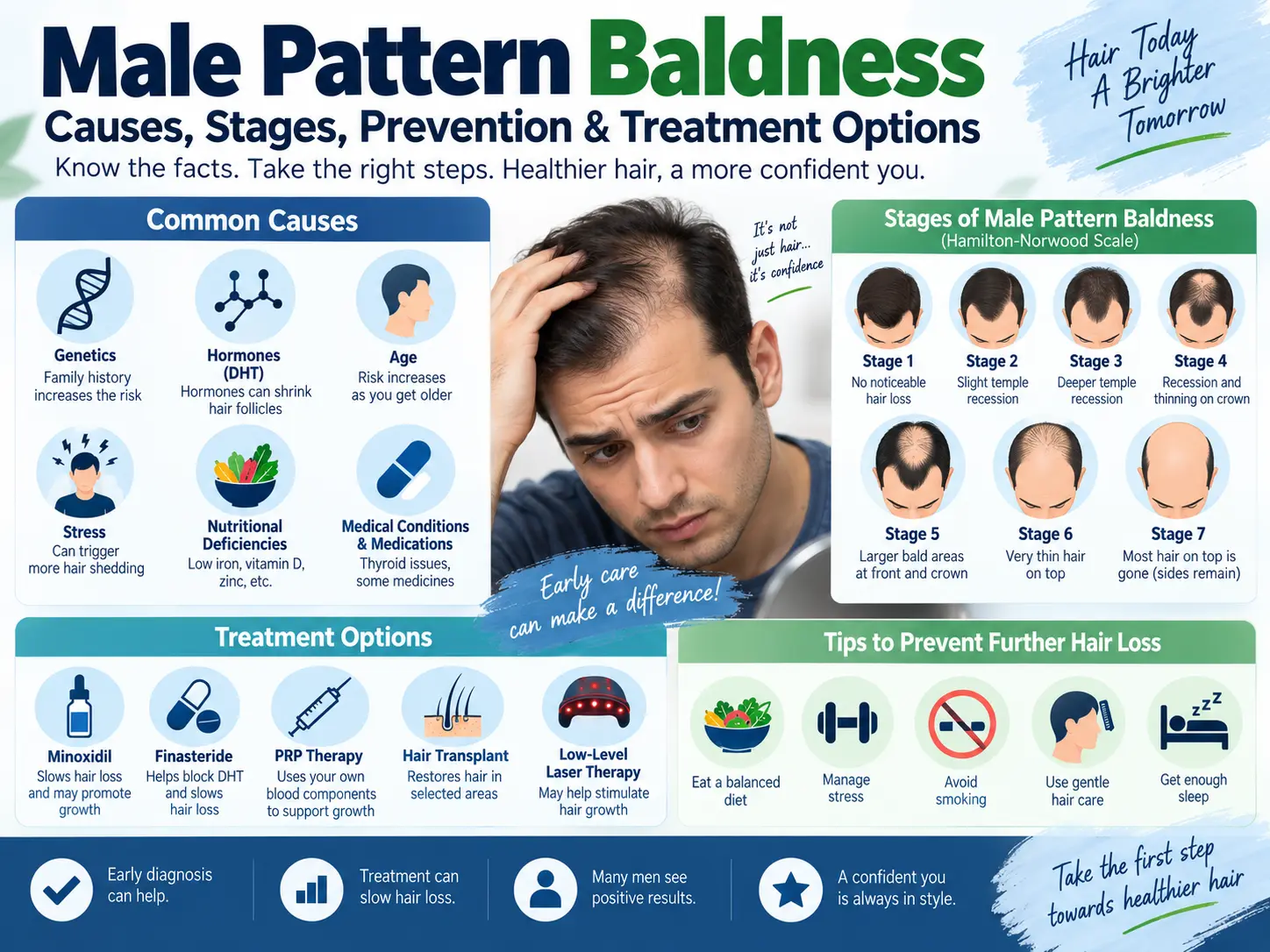
Male pattern baldness is one of the most common types of hair loss in men. It usually starts slowly. You may first notice a receding hairline, thinner hair at the temples, or a bald spot on the crown of your head.
The medical name for male pattern baldness is androgenetic alopecia. Genes and hormones both play a role in this condition. The hair follicles slowly become smaller, so the hair becomes thinner and shorter over time.
Male pattern baldness can start at different ages. Some men notice the first signs in their late teens or twenties, while others notice it later in life.
Dr Hera Tabassum at Dr Hera’s Skin and Hair Clinic can examine your scalp and hair pattern to help find the cause of hair loss and discuss suitable treatment options.
Quick answer: Male pattern baldness is usually caused by inherited genes and the effect of androgens on hair follicles. It commonly causes a receding hairline, thinning at the temples and hair loss on the crown. Treatment may slow further hair loss and may improve hair growth in some men. Early treatment often gives better results.
What Is Male Pattern Baldness?
Male pattern baldness is a type of gradual hair loss that usually affects the front, temples and top of the scalp.
The hair follicles become smaller over time. As the follicles become smaller, they produce thinner and shorter hairs. Eventually, some follicles may stop producing visible hair.
Male pattern baldness usually follows a pattern. It does not normally cause sudden round bald patches like alopecia areata.
Common signs include:
- Receding hairline
- Thinning at the temples
- An M-shaped hairline
- Thinning on the crown
- A growing bald spot on the top of the head
- Thinner hair overall
- Increasingly visible scalp
What Causes Male Pattern Baldness?
Male pattern baldness mainly happens because of genetics and hormones.
1. Genetics
Your genes can make your hair follicles more sensitive to certain hormones.
If close family members have male pattern baldness, you may also have a higher chance of developing it.
However, hair loss does not always follow one simple family line. You can inherit hair-loss risk from different sides of your family.
2. DHT and Hair Follicles
DHT stands for dihydrotestosterone.
It is a hormone made from testosterone. In people who are genetically sensitive to DHT, it can cause certain hair follicles to become smaller over time.
The affected follicles may then produce:
- Finer hair
- Shorter hair
- Lighter hair
- Less visible hair
This process is called follicle miniaturization.
3. Age
The chance of male pattern baldness increases with age.
Some men start losing hair early, while others keep most of their hair for many years. Cleveland Clinic reports that male pattern baldness can begin as early as the late teens or early twenties, although it often becomes noticeable later.
4. Other Causes of Hair Loss
Not every case of hair loss in a man is male pattern baldness.
Hair loss can also happen because of:
- Stress
- Illness
- Nutritional problems
- Thyroid problems
- Some medicines
- Scalp infections
- Alopecia areata
- Tight hairstyles
- Hair damage
This is why it is important to identify the cause before starting treatment. The American Academy of Dermatology recommends finding the cause first because different types of hair loss need different treatments.
What Are the Early Signs of Male Pattern Baldness?
Early signs can be easy to miss.
You may notice:
- Your hairline is moving backward.
- Your temples look thinner.
- Your forehead looks larger.
- Your hair part looks wider.
- Hair on the crown becomes thinner.
- More scalp can be seen under bright light.
- Your hair feels less thick than before.
- Your barber notices thinning on the crown.
- Photos show that your hairline has changed.
Early treatment can be useful because hair follicles that are still producing small, thin hairs may respond better than areas where follicles have been inactive for a long time. The AAD states that men who begin treatment soon after noticing hair loss tend to have better results.
Stages of Male Pattern Baldness
Doctors commonly use the Hamilton-Norwood scale to describe the progression of male pattern baldness.
There are seven main stages.
| Stage | What it may look like |
|---|---|
| Stage 1 | Little or no noticeable hair loss |
| Stage 2 | Small recession around the temples |
| Stage 3 | More noticeable temple recession |
| Stage 4 | Deep recession and/or thinning on the crown |
| Stage 5 | Hair loss at the front and crown becomes more connected |
| Stage 6 | Hair between the front and crown becomes very thin or disappears |
| Stage 7 | Most hair on the top of the scalp is gone |
Stage 1: Little or No Hair Loss
The hairline looks normal.
There may be little or no visible recession.
At this stage, it can be difficult to know whether future hair loss will happen.
Stage 2: Early Temple Recession
The hairline starts moving backward around the temples.
The change may be small and easy to miss.
Some men notice a slight change in photographs before they notice it in the mirror.
Stage 3: Noticeable Recession
The temples move further backward.
The hairline may begin to look like an M shape.
Some men also begin to develop thinning on the crown.
Stage 4: Front and Crown Hair Loss
Hair loss becomes more visible.
The hairline has moved further back and a bald or thinning area may appear on the crown.
At this stage, a doctor can usually identify the pattern more easily.
Stage 5: Larger Areas of Hair Loss
The front and crown areas become larger.
The band of hair between these areas becomes thinner.
Stage 6: Advanced Hair Loss
Hair loss from the front and crown areas joins together.
Most of the top of the scalp may have very little hair.
Stage 7: Advanced Baldness
There may be little or no hair on the top of the scalp.
A band of hair may remain around the sides and back.
Not every man reaches Stage 7.
Male Pattern Baldness vs Other Hair Loss
It is important to know that all hair loss is not male pattern baldness.
| Type of hair loss | Common sign | Possible cause |
|---|---|---|
| Male pattern baldness | Receding hairline and crown thinning | Genetics and hormones |
| Telogen effluvium | Heavy shedding from all over the scalp | Stress, illness or other triggers |
| Alopecia areata | Round bald patches | Immune system |
| Traction alopecia | Hair loss where hair is pulled | Tight hairstyles |
| Scarring alopecia | Hair loss with scalp inflammation or scarring | Certain scalp diseases |
| Hair breakage | Short broken hairs | Heat, chemicals or physical damage |
If your hair loss is sudden or appears as round patches, do not assume it is male pattern baldness.
How Is Male Pattern Baldness Diagnosed?
A dermatologist can usually diagnose male pattern baldness by looking at the hairline and scalp.
Dr Hera Tabassum can assess the pattern of hair loss at Dr Hera’s Skin and Hair Clinic and check whether the hair loss looks like male pattern baldness or another condition.
During a consultation, your doctor may ask:
- When did the hair loss begin?
- Is it getting worse?
- Did it start suddenly or slowly?
- Does anyone in your family have hair loss?
- Do you have itching or pain?
- Are there bald patches?
- Have you recently had an illness?
- Have you lost a lot of weight?
- What medicines do you take?
- Do you have any medical conditions?
- What hair products or treatments do you use?
The scalp will also be examined carefully.
The AAD explains that a dermatologist may use medical history, scalp examination and hair-pull testing to understand the cause of hair loss. Blood tests or a scalp biopsy may sometimes be needed when another disease, deficiency, infection or scalp condition is suspected.
What Is Trichoscopy?
Trichoscopy is a close examination of the scalp and hair using a special magnifying device.
It can help a dermatologist look at:
- Hair thickness
- Hair density
- Hair follicle openings
- Different hair shaft sizes
- Scalp changes
- Signs of inflammation
It can be useful when the doctor needs more information about the type of hair loss.
Do Men Need Blood Tests for Hair Loss?
Not every man with male pattern baldness needs blood tests.
If your hair loss looks like typical male pattern baldness, a doctor may diagnose it mainly through examination and history.
Blood tests may be considered if your doctor thinks another problem could be causing or worsening the hair loss.
For example, testing may be considered when there are signs of:
- Thyroid disease
- Nutritional deficiency
- Hormonal problems
- Other medical conditions
Cleveland Clinic notes that blood tests may be used to check issues such as thyroid function and iron levels when investigating hair loss.
Can Male Pattern Baldness Be Prevented?
There is currently no guaranteed way to prevent inherited male pattern baldness.
This is because genes play a major role in the condition.
However, you can protect your hair and reduce avoidable hair damage.
Helpful habits include:
- Eat a balanced diet.
- Get enough protein.
- Avoid crash diets.
- Avoid very tight hairstyles.
- Be gentle when brushing wet hair.
- Avoid unnecessary harsh chemical treatments.
- Limit excessive heat styling.
- Treat scalp conditions early.
- Manage medical conditions with proper care.
- Ask a doctor before taking hair supplements.
Mayo Clinic notes that hereditary male-pattern baldness itself is not generally preventable, but healthy hair-care habits can help reduce preventable forms of hair damage and loss.
Does Stress Cause Male Pattern Baldness?
Stress can affect hair shedding, but stress is not considered the main cause of inherited male pattern baldness.
A major stressful event, illness or other physical stress can trigger telogen effluvium, which causes increased hair shedding.
This type of shedding can sometimes happen together with male pattern baldness.
For example, a man may already have early genetic hair thinning and then experience heavy shedding after a major illness.
This can make his hair look much thinner very quickly.
Male Pattern Baldness Treatment Options
There are several treatment options for male pattern baldness.
The right option depends on:
- Your age
- Stage of hair loss
- How long you have had hair loss
- Family history
- General health
- Other medicines
- Your treatment goals
There is no single treatment that works for every man.
1. Minoxidil
Minoxidil is a commonly used treatment for male pattern hair loss.
It is applied to the scalp.
It may:
- Slow hair loss
- Stimulate hair growth
- Make existing hairs thicker
The AAD says that minoxidil can reduce hair loss and stimulate hair growth, but complete regrowth is unlikely. Results can take around 6 to 12 months, and continued use is needed to maintain benefits.
Possible side effects can include:
- Scalp irritation
- Itching
- Dryness
- Unwanted hair growth in other areas
Use it according to medical advice and product directions.
2. Finasteride
Finasteride is a prescription medicine used to treat male pattern hair loss.
It works by reducing the conversion of testosterone into DHT.
It can help slow further hair loss and may produce some regrowth in some men. The AAD reports that clinical studies have shown finasteride can slow further hair loss in many men.
Finasteride can cause side effects in some men.
Possible side effects include:
- Reduced sexual desire
- Erectile problems
- Breast tenderness or enlargement
- Other adverse effects
Discuss the benefits and risks with a qualified doctor before taking it.
Do not start prescription hair-loss medicines without medical advice.
3. Minoxidil + Finasteride
In some men, a doctor may recommend more than one treatment.
Using treatments together may be considered when one treatment alone is not enough.
The exact treatment plan should be decided after examining the patient.
4. PRP Treatment
PRP means platelet-rich plasma.
During PRP treatment, a small amount of blood is taken and processed. The platelet-rich part is then injected into the scalp.
PRP may help reduce hair loss and improve hair thickness in some people.
However, results can vary.
PRP is not a permanent cure and maintenance treatment may be needed. The AAD and Cleveland Clinic both describe PRP as one treatment option for selected cases of male pattern hair loss.
5. Low-Level Laser Therapy
Some laser or light devices are available for hair loss.
Some studies suggest that certain devices may help hair growth in people with hereditary hair loss.
However, results can vary between devices and patients.
The AAD notes that some home laser devices have FDA clearance, but FDA clearance is different from FDA approval.
6. Hair Transplant
A hair transplant may be considered when there is enough healthy donor hair.
During a transplant, hair follicles are taken from a donor area and placed into areas affected by hair loss.
A transplant can provide permanent hair growth in the transplanted follicles, but it does not stop the underlying genetic hair-loss process in other follicles.
The AAD describes hair transplantation as an option for selected people with male pattern baldness.
Male Pattern Baldness Treatment Comparison
| Treatment | Main purpose | Results take time? | Medical supervision |
|---|---|---|---|
| Minoxidil | Slow loss and support growth | Yes | Recommended |
| Finasteride | Reduce DHT effect and slow loss | Yes | Required |
| PRP | Support hair growth | Yes | Required |
| Laser therapy | Support hair growth | Yes | Recommended |
| Hair transplant | Restore hair in selected areas | Yes | Required |
| Hair styling | Hide thinning | Immediate visual effect | Usually not needed |
Treatment results vary from person to person.
Does Male Pattern Baldness Grow Back Naturally?
Inherited male pattern baldness usually does not simply reverse on its own.
Without treatment, it can continue gradually.
However, other types of hair loss may improve when the cause is corrected.
For example, hair shedding after an illness or another temporary trigger may improve after recovery.
This is why getting the correct diagnosis is important.
When Should You See a Dermatologist?
See a dermatologist if:
- Your hairline is changing quickly.
- You are losing large amounts of hair.
- You develop bald patches.
- Your scalp is painful.
- Your scalp is red or swollen.
- You have severe itching or scaling.
- Eyebrows or eyelashes are also falling out.
- Hair loss starts suddenly.
- You are not sure what is causing the hair loss.
- You want to start medical treatment.
Early assessment can help identify the cause and discuss treatment before hair loss becomes more advanced.
Hair Care Tips for Men With Hair Loss
Good hair care cannot remove genetic male pattern baldness, but it can help reduce avoidable hair damage.
Eat a balanced diet
Try to eat a variety of:
- Protein-rich foods
- Vegetables
- Fruits
- Whole grains
- Healthy fats
Avoid crash diets
Very low-calorie diets can affect hair growth.
If you are trying to lose weight, use a safe and balanced plan.
Be gentle with your hair
Avoid pulling or brushing your hair too hard.
Wet hair can be easier to damage.
Avoid excessive heat
Frequent high heat from hair dryers, straighteners and other styling tools can damage hair.
Avoid unnecessary supplements
Hair supplements are not a universal solution.
If you have a deficiency, your doctor can advise you about the right supplement and dose.
Common Myths About Male Pattern Baldness
Myth 1: Wearing a cap causes baldness
There is no good evidence that normal cap use causes male pattern baldness.
Myth 2: Shampoo causes male pattern baldness
Normal shampoo use does not cause inherited male pattern baldness.
However, harsh products may irritate the scalp or damage the hair shaft.
Myth 3: Cutting your hair makes it grow thicker
Cutting hair does not change the hair follicle.
Hair may look thicker after cutting because the ends are blunt.
Myth 4: More vitamins always mean more hair
Taking large amounts of vitamins does not automatically make hair grow faster.
Some supplements can also cause problems when taken in excess.
Myth 5: Male pattern baldness happens only to older men
No.
It can start in younger men, including the late teens or twenties.
Myth 6: Hair loss always means you are unhealthy
Not necessarily.
Male pattern baldness is often related to genetics and hormones.
Frequently Asked Questions About Male Pattern Baldness
What is the main cause of male pattern baldness?
The main cause is inherited genetic sensitivity of hair follicles to androgen hormones. This causes affected follicles to become smaller over time.
At what age does male pattern baldness start?
It can start at different ages. Some men notice it in their late teens or twenties, while others develop it later.
What are the first signs of male pattern baldness?
The first signs are often a receding hairline, thinning temples or a small thinning area on the crown.
Can male pattern baldness be cured?
There is no simple permanent cure for the genetic cause. However, treatments can slow hair loss and may improve hair growth in some men.
Is male pattern baldness permanent?
Without treatment, genetic male pattern baldness can continue over time. Treatment may help slow the process or improve hair growth.
Can minoxidil stop baldness?
Minoxidil can help reduce hair loss and stimulate some hair growth in many people, but it cannot guarantee complete regrowth. Benefits usually require continued use.
Can finasteride regrow hair?
Finasteride can slow hair loss and may help some men regrow hair. Results vary, and it is a prescription medicine that should be discussed with a doctor.
Is PRP effective for male pattern baldness?
PRP may help some men improve hair thickness or reduce hair loss, but results vary and maintenance treatments may be needed.
Is a hair transplant permanent?
Hair transplanted from a suitable donor area can provide long-lasting or permanent growth, but the original hair-loss condition can continue affecting other hair.
Can stress cause baldness?
Severe stress can trigger temporary increased hair shedding. It is different from genetic male pattern baldness, although both conditions can occur in the same person.
Can diet stop male pattern baldness?
A healthy diet supports normal hair growth, but diet alone cannot remove the genetic cause of male pattern baldness.
Should I see a dermatologist for a receding hairline?
Yes, especially if the hair loss is increasing or you are unsure of the cause. A dermatologist can determine whether it is male pattern baldness or another type of hair loss.
If you are noticing a receding hairline, thinning crown or increasing hair loss, do not wait until the hair loss becomes severe before getting an assessment.
Dr Hera Tabassum at Dr Hera’s Skin and Hair Clinic can assess the scalp and hair pattern and discuss suitable treatment options based on the cause and stage of hair loss.
The goal of treatment is not the same for every person. For one man, slowing further hair loss may be the main goal. Another person may want to improve hair density or discuss hair restoration.
A proper consultation helps you understand your options before choosing a treatment.
Key Takeaway
Male pattern baldness is a common form of genetic hair loss in men. It usually develops slowly and often begins with temple recession, a receding hairline or thinning on the crown.
The condition can progress through different stages, but early diagnosis and treatment can help in many cases.
If you are concerned about hair loss, Dr Hera Tabassum at Dr Hera’s Skin and Hair Clinic can help assess the pattern of hair loss and guide you toward appropriate options.
Medical Disclaimer
This article is for general education only. It does not replace a medical examination or personal medical advice. Hair loss can have many causes. Prescription medicines such as finasteride should only be used after discussion with a qualified healthcare professional. Treatment results vary between individuals.